 Whatsapp


You’ve been buying the same toothbrush at the supermarket for years — the one you’ve always used, the one that costs two euros and gets the job done. And yet, at every check-up your dentist brings up plaque again. Not because you brush badly, but because there’s a physical limit to what a human hand can do in two minutes. That, at its core, is the question behind the eternal electric vs manual toothbrush debate: not which is more expensive or more modern, but which better protects your mouth in the long run.
The answer is no longer just a dentist’s opinion. Science has been accumulating evidence for years, and it’s worth knowing before your next purchase.
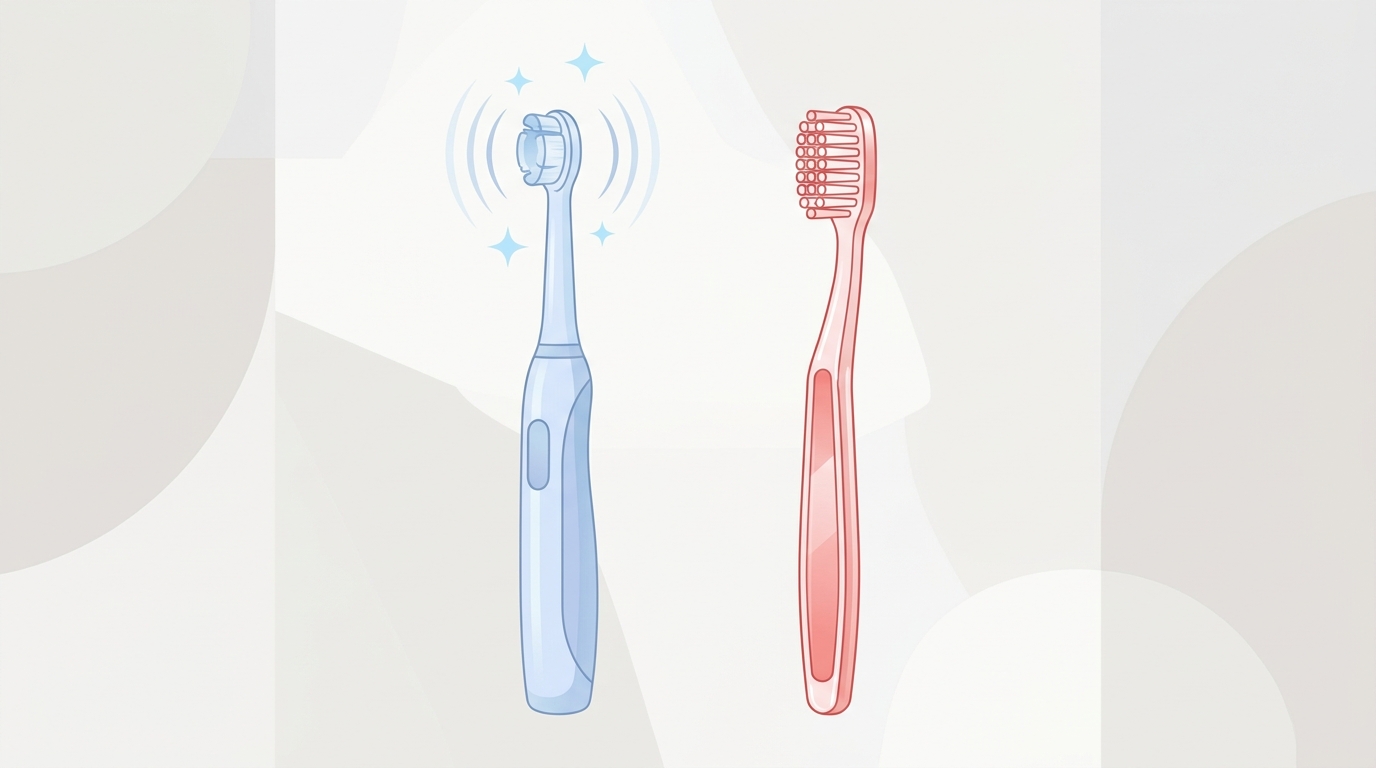
What the scientific evidence says: the Cochrane study
The most solid reference in this debate is the systematic review published by Cochrane Oral Health (DOI: 10.1002/14651858.CD002281.pub3), which analysed more than 50 clinical trials involving thousands of patients of different ages. Its conclusions are clear: electric toothbrushes reduce bacterial plaque by 21% more than manual ones after three months of continuous use.
The plaque reduction is 11% between the first and third month of use, reaching 21% after three months; regarding gingivitis, the electric brush reduces it by 6% in the first months and by 11% after the third month. These are not anecdotal figures: we are talking about a clinically relevant difference in the health of your gums.
Only some electric toothbrushes with a rotation-oscillation action achieved a significant reduction in plaque and gingivitis compared to manual ones. This nuance is important: not all electric models are equivalent, and we will look at this in detail later.
The use of electric toothbrushes, compared to manual ones, achieves a greater reduction in dental plaque and gingivitis in both the short and long term, in both children and adults. According to the ADA (American Dental Association), electric toothbrushes are superior to manual ones.
Electric vs manual toothbrush: advantages and disadvantages of each
Before making a decision, it’s worth having an honest view of what each option offers. Neither is perfect for every profile.
The electric toothbrush
- Greater effectiveness against plaque: clinical studies have shown that electric toothbrushes remove more plaque than manual ones, especially oscillation-rotation models, which access hard-to-reach areas such as the gum line or back molars more effectively.
- Built-in timer: people who use an electric toothbrush tend to brush for longer, especially when the model includes a timer.
- Pressure sensor: some models offer pressure sensors to prevent damage to the gums, which is very useful if you tend to press too hard.
- Less technical effort: the toothbrush itself provides the movement and you only have to guide it, which reduces the margin for error in technique.
- Disadvantages: higher initial cost, requires charging or batteries, replacement heads have a price, and it can be uncomfortable after certain oral procedures.
The manual toothbrush
- Accessible and lightweight: the manual toothbrush is simpler, lighter and does not need to be recharged or use batteries.
- Total control: for those who have mastered the Bass technique — a 45-degree angle, short strokes from the gum towards the tooth — it can be just as effective in everyday use.
- Recommended at certain times: if you have undergone oral surgery or a procedure and have stitches or sensitive areas, your dentist may recommend gentle manual brushing.
- Disadvantages: requires a more refined technique, it is easier to miss hard-to-reach areas, and it provides no feedback on pressure or time.
Types of electric toothbrush: not all are the same
If you have already decided on an electric toothbrush, the next step is to choose the right type. Electric toothbrushes are classified according to the type of movement: rotary or oscillating, and sonic.
- Oscillation-rotation: the head rotates in both directions alternately. These are the ones that have achieved the most significant reduction in plaque and gingivitis in comparative studies. This is the technology most strongly supported by the Cochrane review.
- Sonic: works with high-frequency vibrations and lateral movements. It is especially recommended for people with sensitive gums, dental implants and orthodontics, as it provides effective cleaning between teeth while being gentle on the gums.
- Ionic: ionic toothbrushes have shown a significant reduction in plaque and gingivitis in short-term evaluations, although the accumulated evidence is less than for oscillation-rotation models.
In terms of price, entry-level oscillation-rotation models range from €30–60; mid-range models with pressure sensors and multiple modes, between €80 and €150; and premium models with Bluetooth connectivity, above €200. Many electric toothbrushes feature technological functions worth considering: the timer is very useful for ensuring you brush for the minimum recommended time, and the pressure sensor can be very practical for people with gingivitis or periodontitis.
Which one suits you according to your profile?
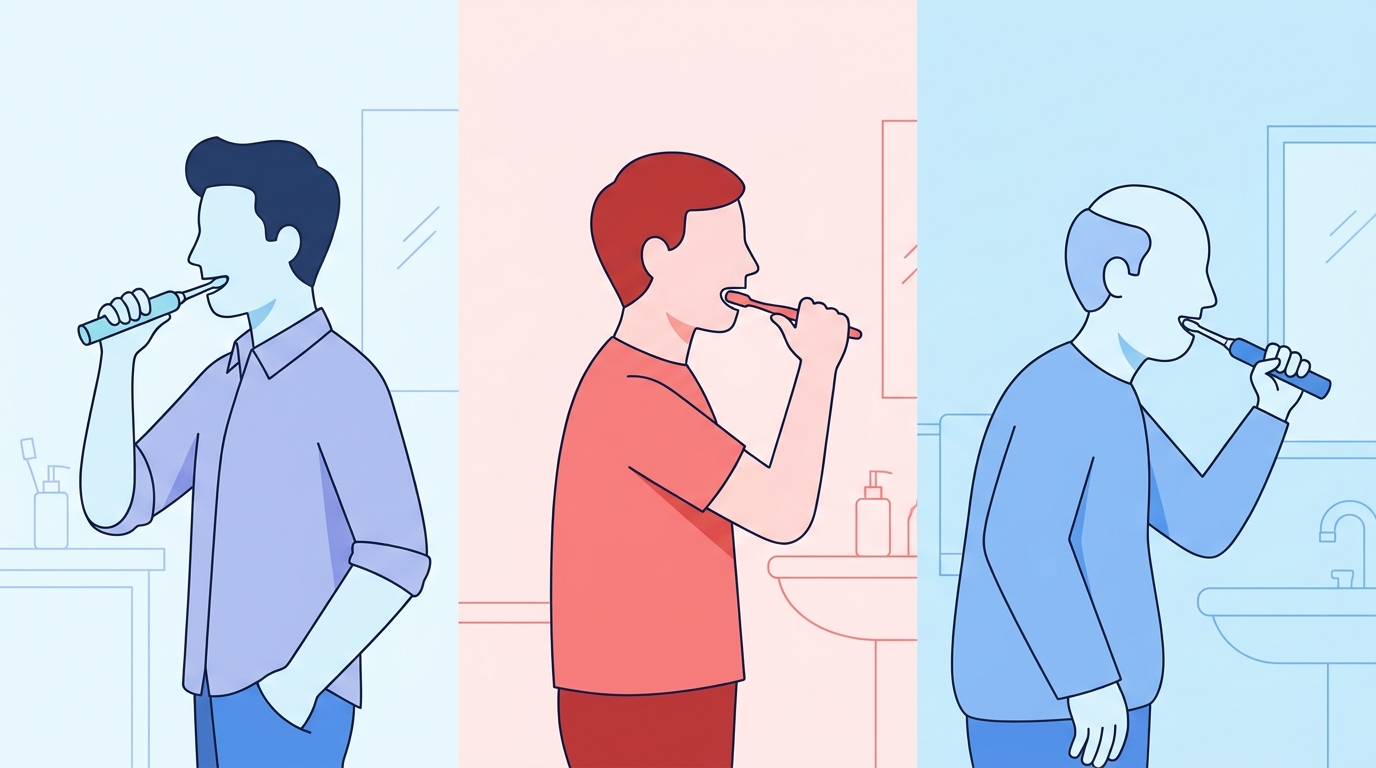
There is no universal toothbrush. The ideal choice depends on who you are and what your mouth is like.
Special profiles: orthodontics, implants, children and reduced mobility
- Fixed orthodontics (braces): braces create corners where plaque accumulates easily. An electric toothbrush is more effective for people wearing braces. The round head of a rotary model can surround each bracket more precisely than the flat bristles of a manual brush.
- Dental implants: the sonic toothbrush is the most recommended option, as its vibrations clean the peri-implant area without exerting direct mechanical pressure on the crown.
- Dental sensitivity or delicate gums: choose an electric model with a “sensitive” mode and pressure sensor. In people with inflamed gums, gingivitis or a history of periodontitis, the use of electric toothbrushes has shown a more significant reduction in plaque and gingival bleeding than manual brushing.
- Reduced mobility or arthritis: the electric toothbrush is especially recommended for people with physical or cognitive disabilities, as the automatic movement compensates for a lack of manual dexterity. The thick, ergonomic handle of most models also makes gripping easier.
- Children: the use of electric toothbrushes achieves a greater reduction in plaque and gingivitis in both the short and long term in children as well. There are models with small heads adapted to their mouths and timers with sound signals that make brushing more fun. It is recommended from the age of 3 under adult supervision.
- Adults without special conditions and good technique: a quality manual toothbrush, with soft bristles and correct technique, can be perfectly sufficient. In this case, the key is consistency and technique, not the device.
Brushing technique: the factor nobody mentions
The best toothbrush in the world is useless if you use it incorrectly. This is probably the most overlooked variable in the electric vs manual debate.
With an electric toothbrush: spend at least two minutes, brushing for 30 seconds in each section of the mouth — upper right, upper left, lower right and lower left — both in the morning and at night. Do not make back-and-forth movements: the toothbrush itself provides the movement, you only have to guide it tooth by tooth, resting the head at the junction between tooth and gum.
With a manual toothbrush: place the bristles at a 45-degree angle to the gum and make short, gentle strokes from the gum towards the tooth, never horizontally. It is very important that brushing goes from gum to tooth, passing several times over the same area and ensuring that the junction between tooth and gum is free of bacteria.
In both cases, it is advisable to change the toothbrush — or the electric head — every three months. Worn bristles lose effectiveness and can irritate the gums.
Debunking myths about the electric toothbrush
There are two questions we frequently hear at the clinic that deserve a direct answer.
"Does an electric toothbrush damage enamel or gums?"
This is the most widespread myth. The short answer is: no, if used correctly. What damages enamel and gums is not the type of toothbrush, but excessive pressure and hard bristles. Hard bristles are not recommended because they damage enamel; they are only suggested in cases of very poor oral hygiene. An electric toothbrush with an active pressure sensor is, in fact, safer for the gums than a manual one used with too much force, because it alerts you when you are pressing too hard. A systematic review has found that both types of toothbrushes are equally safe.
"Is brushing for one minute enough?"
No. The minimum recommended time is two minutes, twice a day. In less than that time it is practically impossible to cover all tooth surfaces — outer, inner and occlusal faces — with the attention each area requires. Most people who think they brush well stop at 45–60 seconds. The electric toothbrush timer exists precisely to correct this habit.
The toothbrush within a complete hygiene routine
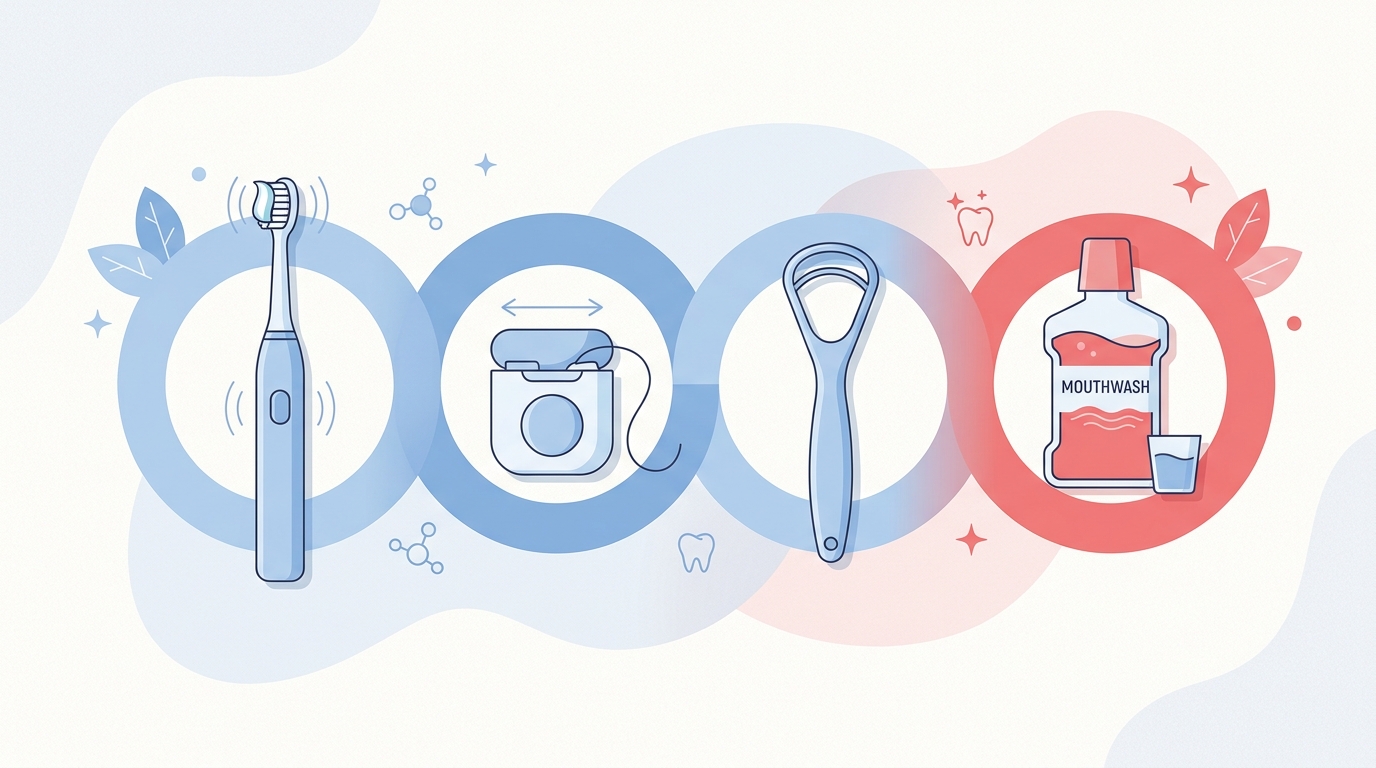
Not even the best electric toothbrush on the market reaches every corner. The spaces between teeth — where up to 40% of plaque accumulates — are beyond the reach of any brush head. That is why, at Platón Dental, we insist that brushing is the first step of a routine, not the only one.
- Dental floss or interdental tape: use it at least once a day, preferably at night, before brushing. It removes plaque and food debris from the spaces the toothbrush cannot reach.
- Oral irrigator: especially useful if you wear braces, have implants or have periodontal pockets. It complements — but does not replace — dental floss.
- Fluoride mouthwash: use it after your evening brushing, without rinsing with water afterwards, so that the fluoride can act overnight.
- Professional check-up every 6 months: despite good brushing, there will be areas we cannot reach and plaque will gradually harden over time, forming tartar, which causes conditions such as cavities and periodontitis; that is why it is advisable to visit the dental clinic every 6 months.
Comparison table: electric vs manual at a glance
| Criterion | Electric toothbrush | Manual toothbrush |
|---|---|---|
| Effectiveness against plaque | Superior (up to 21% more at 3 months) | Good with correct technique |
| Gingivitis reduction | Superior (up to 11% more at 3 months) | Moderate |
| Ease of use | High (the brush does the movement) | Requires refined technique |
| Initial price | €30–200 (+ replacement heads) | €2–15 |
| Maintenance | Head every 3 months, periodic charging | Full replacement every 3 months |
| Ideal for | Orthodontics, implants, reduced mobility, children, sensitive gums | Adults with good technique, post-oral surgery |
| Enamel safety | High (with pressure sensor) | High (with soft bristles and correct technique) |
So, which is better?
The scientific evidence tips the balance towards the oscillation-rotation electric toothbrush as the most effective option for most people. It reduces plaque more, improves gum health and compensates for the technique errors we all make without realising. If you have braces, implants, sensitive gums or simply want to make sure you do a good job every night, it is the choice most strongly supported by science.
That said, the manual toothbrush is not obsolete. In the hands of someone with good technique, soft bristles and consistency, it remains a valid tool. The problem is that this perfect combination is rarer than we think.
What is universal, regardless of the toothbrush you choose: two minutes, twice a day, with dental floss and regular check-ups with your dentist. Without that, not even the most expensive model on the market can protect you from plaque.
At Platón Dental we can help you determine which type of toothbrush best suits your mouth, your routine and your dental history. Because the best oral hygiene doesn’t start at the pharmacy: it starts with the right advice for your specific case. Also visit our resources on dental health prevention to complete your care routine.