 Whatsapp


In the age of Instagram filters and Hollywood smiles, we are constantly bombarded with images of celebrities sporting immaculate, almost artificial white teeth, and it is natural that when we look in the mirror, we feel that our smile has faded or yellowed.
Teeth whitening is undoubtedly the most sought-after cosmetic treatment in clinics. And it makes perfect sense: a bright smile is instinctively associated with youth, hygiene and health. However, it is also the treatment that causes the most frustration if the rules of the game are not clearly explained before starting.
Many patients come to the clinic asking for a ‘white tooth’ or a ‘white smile’. This is where we must start with the uncomfortable truth: natural human teeth are not pure white.
>>> Do you live in Mallorca? Book your free first appointment <<<
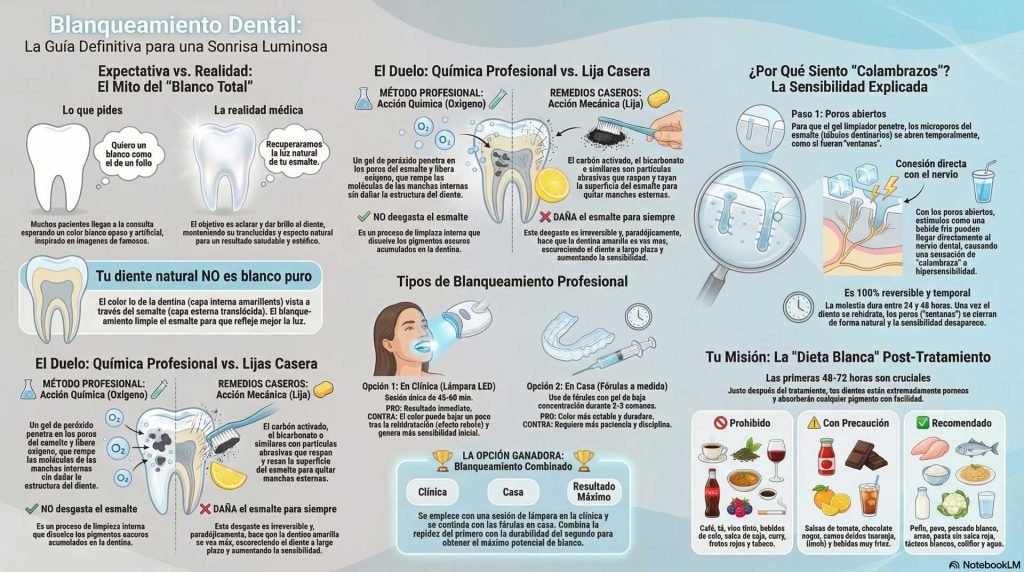
The colour of your teeth is determined by the dentine (the inner layer), which is yellowish, seen through the enamel (the outer layer), which is translucent. Over time, the enamel wears away and reveals more of that yellow background. What professional whitening does is not “paint” the tooth white, but deeply clean the enamel so that it regains its original brightness.
In this article, we’ll explain what you can really expect from this treatment, why those TikTok “home remedies” can permanently damage your enamel, and the crucial difference between having white teeth and wearing veneers.
“I want teeth the color of [TV celebrity]. I want them to be completely opaque white, like a sheet of paper.”
“We will restore the maximum light potential of your enamel. They will be lighter and brighter, but will retain the naturalness and transparency of your teeth.”
How does teeth whitening really work? (The simple chemistry)
To understand how whitening works, we must first dispel the idea that we are “painting” the tooth. We do not apply a white coating on top, but rather clean the darkness from within.
Imagine you have a white linen shirt that, over time and with repeated washing, has turned yellowish or greyish. If you rub the fabric with a hard brush (abrasion), you will only damage the fibres. What you need is a product that penetrates the fabric and ‘breaks down’ the dirt molecules.
The same thing happens in dentistry. Your tooth enamel is not impermeable; it is porous, like a microscopic sponge. Pigments from coffee, wine or tobacco enter through these pores and settle in the inner layer (dentine).
Professional treatment uses a peroxide gel (hydrogen or carbamide). This gel does not scrape or sand the enamel. When applied, it gently penetrates the pores and releases oxygen.
This is where the magic happens: oxygen molecules seek out the dark pigment molecules that have stained your tooth and break their chemical bonds. By “breaking” these internal stains, the tooth allows light to pass through again and regains its natural brightness. Therefore, whitening does not alter the structure of your tooth, it only changes the way it reflects light.
What many “whitening” toothpastes and activated charcoal do. They scrape the surface to remove external stains, but wear down the enamel over time.
What professional gel does. It enters the pore and dissolves the internal stain without touching the enamel surface. It does not wear down the tooth.
Types of whitening: Lamp, trays or combined?
When you decide to whiten your teeth, you are faced with a menu of options that can be confusing. Is it better to do it in a quick session at the clinic or gradually at home? The short answer is: ideally, you should combine both approaches.
Let us look at the differences so that you understand what you are purchasing:
- In-clinic whitening (photoactivation/lamp) This is the “intensive” treatment. A highly concentrated gel is used, which is activated by a cold LED light.
- The good: The results are immediate. You see the change in 45 minutes.
- The fine print: Part of that “immediate whitening” is due to the tooth becoming dehydrated during the session. When the tooth rehydrates a couple of days later, the colour fades slightly (rebound effect). In addition, there is usually more acute sensitivity on the same day.
- Home whitening (custom-made trays) Not to be confused with pharmacy kits. The dentist makes transparent moulds that fit your mouth perfectly and gives you syringes of professional gel (lower concentration) to apply while you sleep or for a few hours a day for 2-3 weeks.
- The good: It is a real, deep whitening. As it is slower, the colour sets better in the tooth structure and is much more stable in the long term.
- The fine print: It requires discipline and patience on your part.
- The winning option: Combined whitening This is the protocol recommended by specialists. It consists of starting with a lamp session at the clinic to give the initial boost and open the pores, and continuing at home with the trays for 15 days.
- Why is it the best? You get immediate satisfaction from the colour change, but you ensure stability and durability with the at-home treatment. It’s the only way to achieve the maximum whitening potential of your enamel.
❌ Shorter-lasting colour
✅ Stable and long-lasting colour
❌ Requires patience
The dark side: Activated charcoal, lemon and bicarbonate of soda
The internet is full of “natural remedies” that promise to whiten your teeth for little money. Activated charcoal, pure bicarbonate of soda with lemon, banana skins… They sound harmless because they are “natural”, but the reality is that they are the number one enemy of your tooth enamel.
To help you understand visually: professional whitening is chemical; home remedies are sandpaper.
Activated charcoal and baking soda powder are abrasive particles. When rubbed against your teeth, they effectively remove surface stains, but they do so by scratching the enamel. Imagine cleaning your glasses with an aluminium scouring pad: you will remove the dirt, yes, but you will leave the glass covered with irreversible micro-scratches.
Lemon is even worse: it is a powerful acid that decalcifies and erodes enamel (chemical erosion).
The sad irony: If you overuse these methods, you will wear down the enamel (which is white) so much that it will become transparent and reveal the dentine (which is yellow). In other words, by trying to whiten your teeth at home, you will end up with yellower and more sensitive teeth forever.

Post-treatment care (The “white diet”)
You have just invested in improving your smile, and your teeth are brighter than ever. Now it is time to do your part: protect the results.
Remember what we explained about “open windows”. During the 48-72 hours following treatment, your teeth are extremely permeable. They are thirsty and will absorb any pigment you give them. If you drink black coffee as soon as you leave the clinic, you are very likely to lose much of the effect achieved.
We call this the White Diet. During the first two or three days, you should avoid foods with strong colourings (natural or artificial) and acids at all costs.
Whitening is not a permanent tattoo; it is maintenance. Over time, your teeth will naturally darken again due to age and diet, but if you follow these tips and do a little annual refresher (using the trays at home for a couple of nights), you can maintain that brightness for years.
Does it hurt? Let’s talk about tooth sensitivity.
Let’s be clear: yes, whitening can cause sensitivity. If someone promises you that it is “100% painless” in all cases, they are not telling you the whole truth. But there is a big difference between “damage” and “temporary sensitivity”.
For whitening to work, we need the gel to penetrate down to the dentine. To do this, the micro-pores in the enamel (called dentinal tubules) must be opened and cleaned.
Imagine that your tooth is a house with the windows closed. Normally, the cold or heat from outside does not enter. During whitening, we open all the windows at once to clean thoroughly. What happens? If a draught (a cold drink) enters, you feel it directly in the nerve.
This sensation, known as “tooth sensitivity” or hypersensitivity, is completely reversible. Once the treatment is complete and the tooth is rehydrated, these “windows” close again naturally. The discomfort usually lasts between 24 and 48 hours. If you experience it, don’t panic: it means that the product is penetrating, but your dentist can give you desensitising gels to soothe the nerve in the meantime.
Prohibited (48 hours)
Coffee, tea, red wine, soy sauce, curry, red fruits, beetroot, tobacco, and cola drinks.
With caution
Tomato sauces, dark chocolate, acidic juices (orange/lemon) or very cold drinks.
Recommended
Chicken, turkey, white fish, rice, pasta (without red sauce), white dairy products, cauliflower, and water.