 Whatsapp


Have you ever run your tongue over your teeth when you wake up in the morning and noticed a rough, coarse or ‘paste-like’ surface, as if you had a thin layer of dirt stuck to them? That feeling is unmistakable and has a name: bacterial plaque.
Often, at the dentist’s office, we assume that everyone understands the seriousness of this concept, but the reality is that there is a lot of confusion. Most people believe that this “dental plaque” is simply food debris that has become trapped after lunch, but it is much more complex than that. It is a living, invisible and constant ecosystem that forms in your mouth 24 hours a day, whether you eat or not.
Understanding what this silent enemy really is is the first vital step towards having a healthy mouth. Why? Because bacterial plaque is the source of almost everything. It is “patient zero” which, if not removed in time, triggers a dangerous domino effect: it calcifies becoming dental tartar, its acids cause tooth decay and its accumulation inflames your gums, causing gingivitis.
In this article, we will explain, without complicated technical terms, how it develops, how it matures and, most importantly, what exactly you should do to keep it at bay and prevent it from damaging your smile.
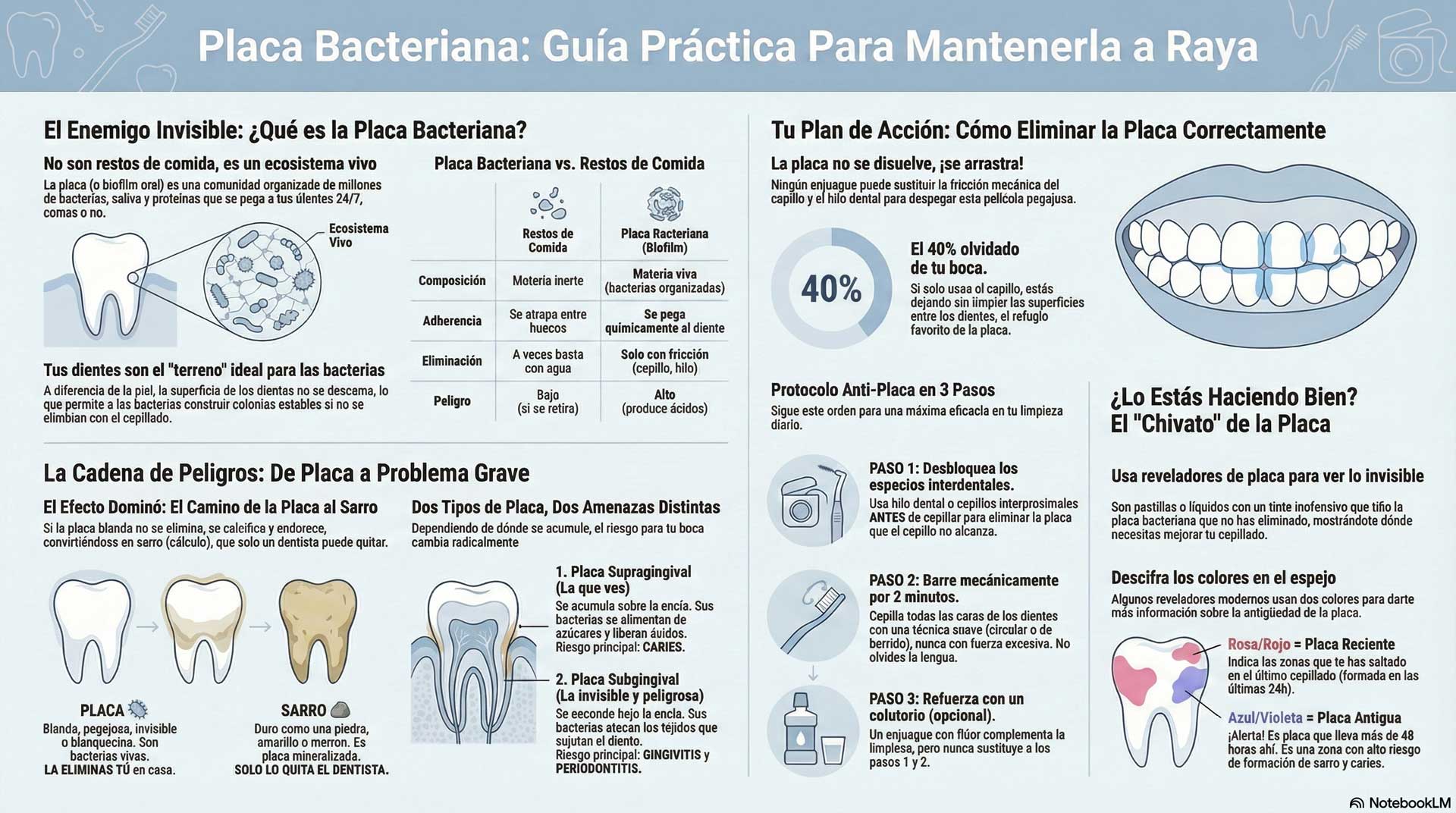
What is bacterial plaque?
If we look for a technical definition, dentists call it oral biofilm. But to put it simply: plaque is not just a random accumulation of dirt, but an organised community of bacteria.
There is a popular belief that bacterial plaque is just leftover bits of breakfast or dinner stuck between your teeth. This is only partly true. Although food debris (especially sugars) serves as “fuel”, plaque is mainly composed of bacteria, saliva and proteins. It is a colourless, sticky film that clings tenaciously to the surface of your teeth.
Why does it form on teeth specifically? Here is an interesting fact that many patients are unaware of. Most of the tissues in your body (such as the skin or the mucous membrane in your cheeks) “shed”; that is, they constantly lose layers of old cells, which prevents bacteria from building stable “homes”.
However, your teeth do not shed their surface. They are hard, stable structures that do not flake off. This makes them the ideal place for bacteria to settle, build their structure (the biofilm) and proliferate undisturbed if we do not bother them by brushing. That is why bacterial plaque on teeth is a constant process: it does not depend solely on whether you have eaten, but on the simple passage of time.
| Characteristic | Food debris | Bacterial plaque (biofilm) |
| What is it? | Inert matter (food particles). | Living matter (millions of organized bacteria). |
| How does it adhere? | It gets mechanically trapped between gaps. | It chemically sticks to the tooth like glue. |
| How is it removed? | Sometimes water or vigorous rinsing is enough. | It can only be removed by physical friction from brushing or flossing. |
| Immediate danger | Low (if removed quickly). | High (produces acids that attack the enamel). |
Stages of bacterial plaque formation
Bacterial plaque does not appear suddenly; it follows a very orderly process of construction, almost as if bacteria were building a city on your teeth. Understanding these stages is crucial to understanding why brushing frequency is so important: we are racing against the clock.
This biological process is mainly divided into three key stages:
1. The formation of the “acquired film”: Just a few minutes after brushing your teeth, proteins from your own saliva are deposited on the enamel, forming an invisible layer. This layer is not bad per se (it protects the tooth from wear), but it acts like double-sided tape: it prepares the ground for bacteria to stick to.
2. Initial colonisation: After a few hours, the first bacteria (called “primary colonisers”) arrive and attach themselves to this film. They are the pioneers who pave the way.
3. Maturation and growth: If you don’t brush them away, these bacteria begin to multiply and attract other, more aggressive species. They begin to secrete a sticky matrix that protects them and binds them together. This is when bacterial plaque becomes “mature” and dangerous. The older the plaque (the longer it has been in your mouth), the more harmful it becomes to your gums and teeth.
- Textura: Blanda, pegajosa y "pastosa".
- Color: Invisible, blanca o amarillenta clara.
- Estado: Bacterias vivas y activas.
(Con cepillo e hilo dental)
- Textura: Dura como una piedra.
- Color: Amarillo oscuro, marrón o negro.
- Estado: Placa mineralizada y calcificada.
(Requiere limpieza profesional)
Types of bacterial plaque and risk areas
Not all plaque is the same, nor does it behave in the same way. Depending on where the bacteria decide to settle, the consequences for your mouth will be completely different. We can classify it mainly by its location, and this is what determines whether you will end up with a filling or a gum problem.
- Supragingival plaque (the plaque you can see). This is the plaque that accumulates above the gum line, on the visible surface of the tooth.
- How does it work? These bacteria (aerobic, they need oxygen) are addicted to sugar. When you eat carbohydrates, they ferment those sugars and release acids.
- The result: Their main consequence is tooth decay. They attack the enamel until it is perforated. This is the most common type in children, due to their diet and less thorough brushing.
- Subgingival plaque (the invisible and dangerous kind). This is the type that concerns dentists the most. It accumulates in the groove between the tooth and the gum, and gradually moves down into the periodontal “pocket”.
- How does it work? Very aggressive bacteria (anaerobic, they do not need oxygen) live here, seeking protein rather than sugar. They do not attack the tooth itself, but rather the tissues that hold it in place.
- The result: They cause gingivitis (inflammation and bleeding) and, if left untreated, periodontitis (bone loss). It is the main cause of healthy tooth loss in adults.
There are also “high-risk” areas where bacterial plaque accumulates more easily due to pure physics: the grooves in the molars (where we chew), the space between teeth (where the toothbrush cannot reach) and the edge where the tooth ends and the gum begins.
Some modern developers use two shades to give you more information:
Meaning: “You missed this area during your last brushing.”
Meaning: “Watch out! You haven't cleaned there in days. High risk of tartar.”
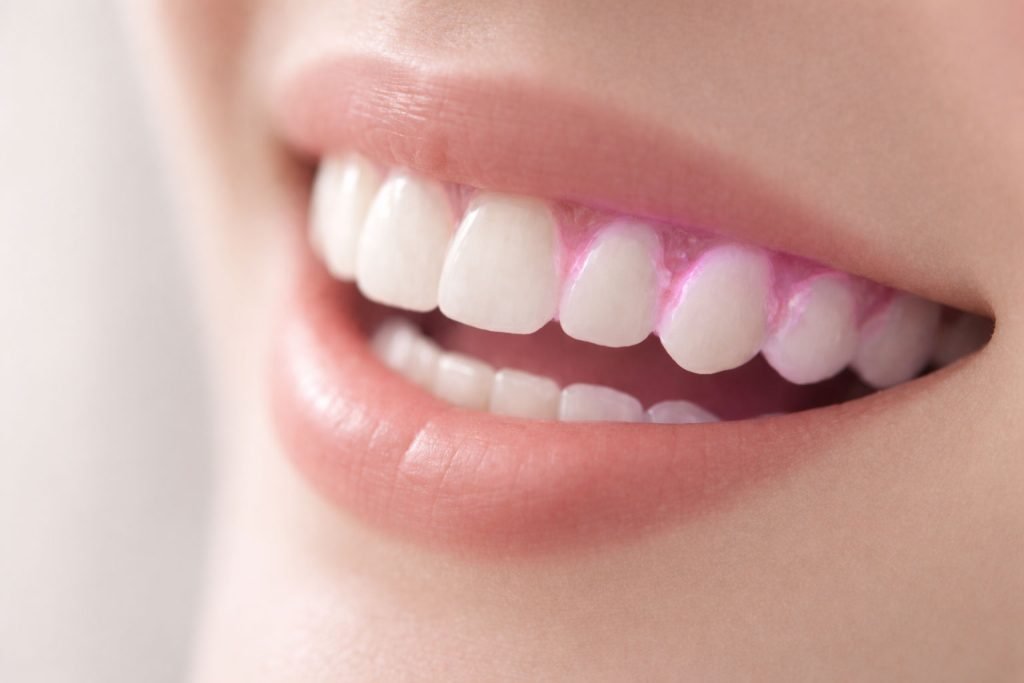
Plaque disclosing agents: The “snitch” you didn’t know about
Have you ever wished you had X-ray glasses to see if you really left any dirty areas after brushing? The good news is that they exist, but in pill or liquid form.
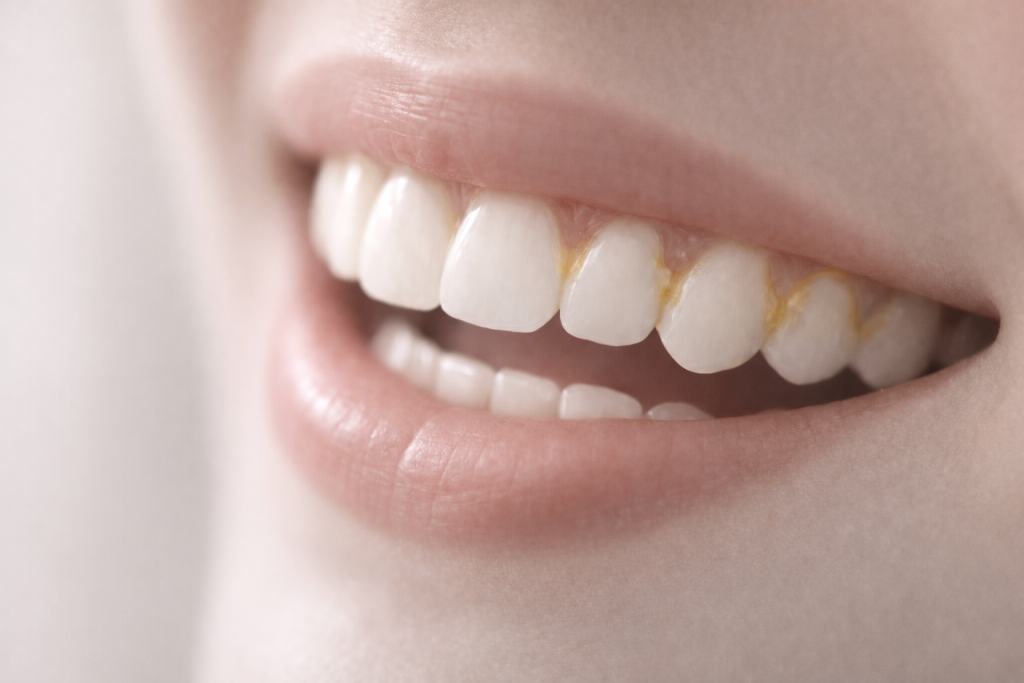
One of the biggest problems with removing plaque is that it is invisible or a pale white colour almost identical to that of the tooth. This makes it very easy to “brush blindly” and leave areas uncleaned, especially on the back teeth or near the gums. This is where plaque disclosing agents come into play.
Dental plaque disclosing solution is a fantastic educational tool, both for adults who want to perfect their technique and for children. Turning brushing into a game of “eliminating blue monsters” is often much more effective than any lecture on health.
These products use harmless vegetable dyes (usually erythrosine) that react chemically with bacterial plaque, staining it a bright colour (red, pink or blue). Basically, they “reveal” where the bacteria are hiding.
How are they used? It’s very simple: after brushing your teeth as usual, chew one of these tablets until it dissolves and mixes with your saliva. Run your tongue over all your teeth, spit it out and look in the mirror. If your mouth looks pink or blue, your brushing has not been perfect. Your mission then is to brush again until all the colour is gone.
Removing bacterial plaque: How to do it properly
At this point, you know that you have a community of bacteria trying to build a structure in your mouth. The question is: how can we effectively destroy it?
The first thing you need to remember is that bacterial plaque does not dissolve, it is removed by scrubbing. There is no magic mouthwash or miracle toothpaste that can remove plaque on its own just by rinsing. As it is a sticky film, it needs mechanical friction to be removed. It’s like trying to clean a plate with stuck-on grease: if you just use soap and water, the grease will still be there; you need to use a scouring pad.
Here are the keys to effective removal:
- Technique beats force: Many patients believe that brushing harder cleans better. Wrong. Brushing too hard only wears down the enamel and recedes the gums, but does not remove plaque better. You need a sweeping technique (from the gum towards the tooth) or gentle circular movements, never horizontal and aggressive ones.
- The great forgotten (40% of your mouth): If you only use a toothbrush, you are leaving 40% of the surface of your teeth uncleaned. The surfaces between your teeth are the perfect hiding place for plaque. If you don’t use dental floss or interdental brushes every day, it’s mathematically impossible to have a clean mouth.
- Persistence is your best weapon: Remember the hourglass. You have about 24 hours before plaque begins to organise itself and become dangerous. A mediocre brushing every three days is useless.
And one final important warning: if you look in the mirror and see hard yellowish or brown deposits near your gums, stop. That is no longer plaque, it is tartar. No matter how much you brush there, you will not remove it (and you could hurt yourself). In that case, the only solution is to make an appointment for professional cleaning.
Unblock the spaces
Before brushing, clean between your teeth with dental floss or interproximal brushes. If you don't remove the plaque from there first, the toothbrush won't be able to reach it.
Mechanical sweeping
Brush all sides of your teeth for at least 2 minutes. Tilt the brush 45º toward the gums. Don't forget your tongue (a major reservoir of bacteria).
Chemical protection (optional)
Finish with a fluoride mouthwash to strengthen clean enamel. Remember: rinsing does not replace steps 1 and 2, it only complements them.
Your health begins with balance
As we have seen, bacterial plaque is not a “punishment” for eating sweets, but a natural biological process that we all live with. You cannot prevent bacteria from trying to colonize your teeth (it is their nature), but you do have the absolute power to prevent them from settling and causing damage.
The key is consistency. Understand that every time you brush your teeth, you are “resetting” your mouth’s biological clock.
However, we are human. Sometimes our technique is not perfect, or we have areas in our mouth that are difficult to reach, where plaque ends up calcifying and turning into tartar. Remember what we’ve learned: once tartar forms, brushing is useless. Trying to remove it yourself will only damage your gums.
That’s why the winning combination is simple: your daily hygiene at home + a regular professional check-up and cleaning to remove anything you may have missed. It’s the cheapest and most effective investment you can make to keep your smile looking good for life.
If you notice roughness, see spots near your gums, or your teeth bleed when you brush, plaque has likely turned into tartar. Don't wait until it hurts.
Request my Professional Cleaning