 Whatsapp


There is a widespread belief that crooked teeth are ‘a child’s problem’ – something that is sorted out with braces during adolescence and then forgotten about for good. The reality is quite different: millions of adults have misaligned teeth, and many of them had straight teeth when they were younger.
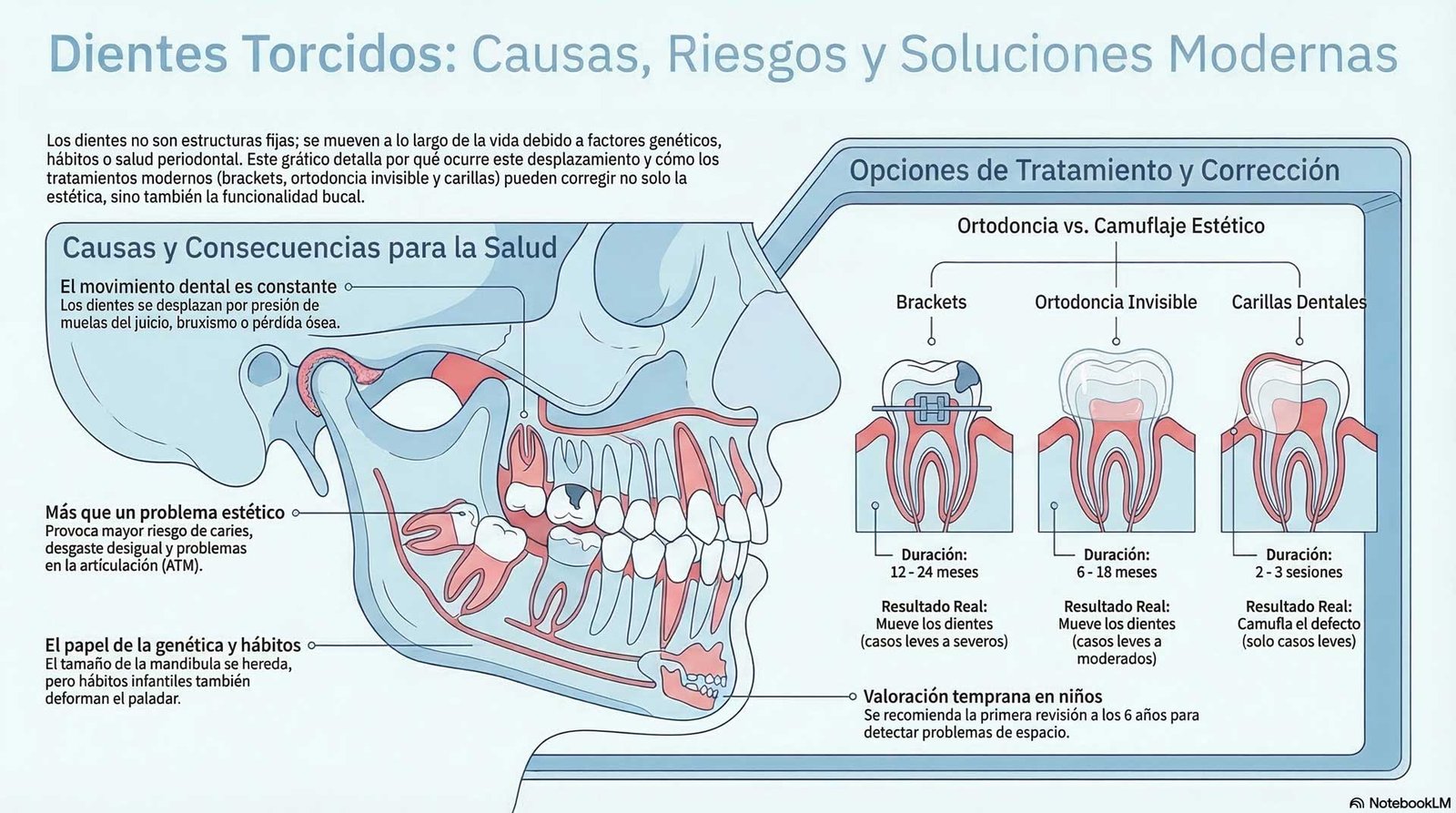
Teeth are not set in cement. They are attached to the bone by an elastic ligament (the periodontal ligament) which allows for constant micro-movements. Over the course of a lifetime, forces such as pressure from wisdom teeth, bruxism, bone loss due to gum disease or simply the natural movement of the teeth can gradually shift them millimetre by millimetre, until one day you look in the mirror and think: “Has it always been like this?”.
In this article, we’ll explain why teeth become crooked (in both children and adults), what real consequences this has beyond aesthetics, and the treatment options available today: from traditional braces to invisible orthodontics and dental veneers. We’ve included indicative prices so you can get an idea of the costs before your consultation.
Why do teeth become crooked? The 6 real causes
There is no single reason. In most cases, it is a combination of genetic and environmental factors that build up over the years:

Crooked teeth are not just a cosmetic issue
Many patients come to the clinic saying, ‘I don’t like them, but they don’t bother me’. And it is true that slightly misaligned teeth are not a medical emergency. But it is worth noting that dental crowding has functional consequences that go beyond what you can see in the mirror:
Increased risk of tooth decay
Crowded teeth create nooks and crannies that a toothbrush cannot reach and where dental floss cannot get in. Plaque builds up and tooth decay occurs precisely in these hard-to-reach areas.
Gum disease
Where plaque accumulates, the gums become inflamed. Chronic crowding promotes gingivitis and, if left untreated, can lead to periodontitis.
Uneven wear
If the teeth do not mesh correctly, some bear more of the load than others. This causes accelerated wear, fractures and sensitivity in specific teeth.
Joint problems (TMJ)
An unbalanced bite can put excessive strain on the temporomandibular joint, causing jaw pain, clicking, headaches and neck pain.
Self-esteem and social life
Not being able to smile with confidence affects personal and professional relationships, as well as one’s self-image. It is just as valid a reason for seeking treatment as any other.

Cómo corregir los dientes torcidos: las 3 opciones reales
Cuando se trata de alinear dientes, solo hay tres caminos legítimos. Cada uno tiene su indicación, sus ventajas y sus limitaciones:
The most versatile treatment. Suitable for everything from mild cases to complex malocclusions. Ceramic and lingual braces offer a more discreet appearance.
Removable, nearly invisible aligners that are replaced every 1–2 weeks. Ideal for adults. They do not interfere with eating habits or oral hygiene.
Thin shells bonded to the tooth surface. They can change shape, size and colour. Suitable only for minor misalignments or as a complement after orthodontic treatment.
Braces or clear aligners? How to choose
This is the million-dollar question for any adult with crooked teeth. The honest answer is: it depends on the individual case, not on the appearance of the appliance. Both systems actually move the teeth, but they are suitable for different situations.
Choose clear aligners if: your misalignment is mild to moderate, you value discretion, you have the discipline to wear the aligners for 22 hours a day, and you don’t have complex bite problems (severe open bite, skeletal crossbite).
Choose braces if: your case is complex (severe crowding, bite problems, teeth rotated by more than 30–40°), you need maximum control over tooth movement, or you prefer a treatment that ‘works on its own’ without relying on your consistency in wearing the aligners.
There is a third, increasingly common scenario: combining orthodontics with veneers. First, the teeth are correctly aligned using orthodontics, and then veneers are fitted to perfect their shape, size and colour. This is the approach that offers the most spectacular aesthetic results, but it is also the most expensive.
Crooked teeth in children: when to seek treatment
If your child has crooked milk teeth, don’t worry. Milk teeth often have gaps or slight rotations that correct themselves when the permanent teeth come through. However, there are signs that do warrant a visit to the orthodontist:
- Premature loss of milk teeth (due to tooth decay or an impact) before the age of 10–11.
- Crossbite (the lower teeth bite over the outside of the upper teeth).
- Thumb-sucking or tongue-thrusting beyond the age of 3–4 years.
- A very narrow palate or chronic mouth breathing (breathing only through the mouth).
The Spanish Society of Orthodontics recommends an initial assessment at 6 years of age. At this age, with the first permanent molars and incisors having already erupted, the orthodontist can detect problems with space or bite and, if necessary, intervene with interceptive orthodontics (simple appliances that make use of the child’s growth to correct the root cause of the problem).

In short: it’s never too late to straighten crooked teeth
Whether you’re a teenager with obvious crowding or a 50-year-old adult who’s noticed that your front teeth have started to shift, there’s a solution and it’s more accessible than ever. Modern orthodontics is faster, more comfortable and more discreet than it was a generation ago.
The important thing is not to take shortcuts. Be wary of miracle cures found online, home-made braces and promises of straight teeth in a matter of weeks. A professional diagnosis will tell you exactly what type of treatment you need, how long it will take and how much it will cost. And from there, the decision is yours.