 Whatsapp


Imagine your dentist has just told you that you need to have a tooth extracted. That part, you can handle. But when the estimate arrives, the implant costs three or four times more than the dental bridge, and your stomach drops. The question you ask yourself in the parking lot is the same one thousands of patients ask every year: Is the difference really worth that much, or are they selling me something I don’t need?
The honest answer is: it depends. And in this article you will understand exactly what it depends on, with clinical reasoning and no beating around the bush.
The price myth: expensive isn't always best (but here it usually is)
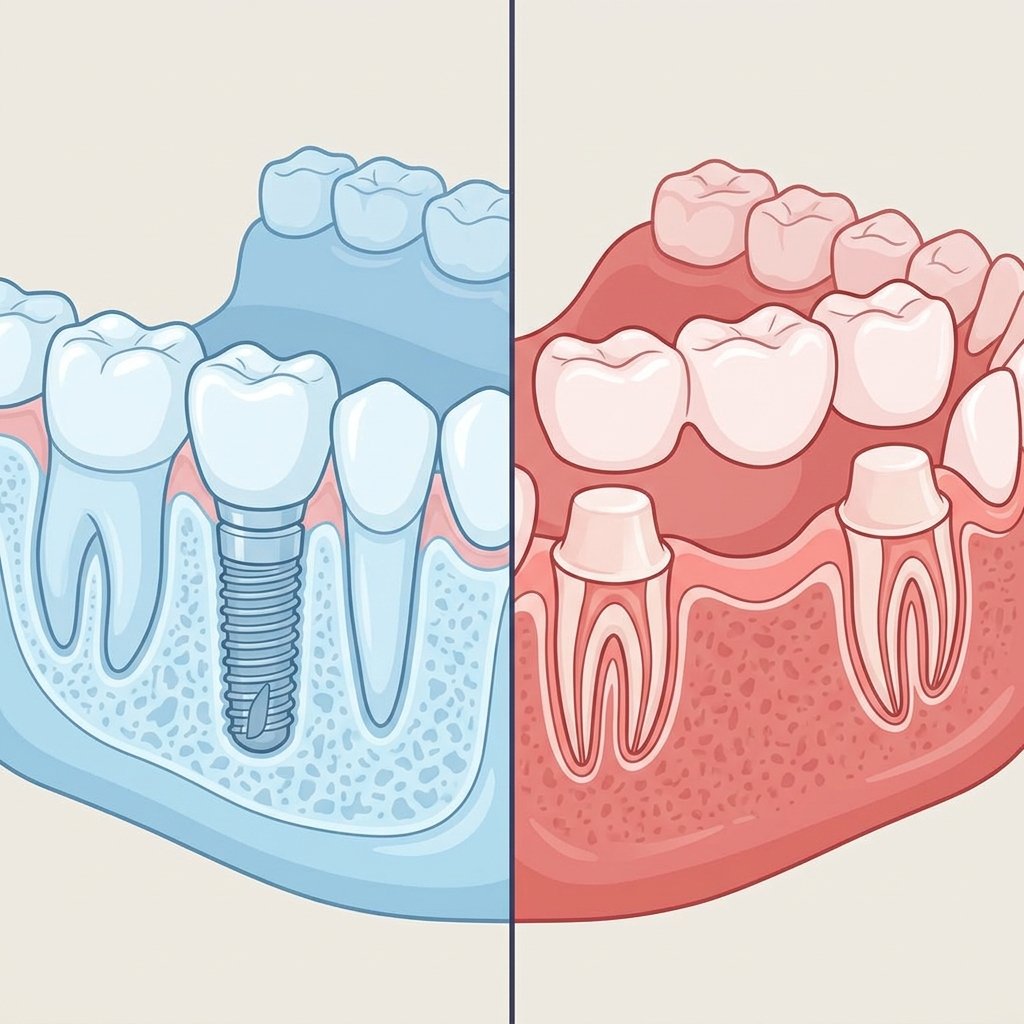
There is a widespread belief that implants are expensive because they are the “luxury” treatment of dentistry. This is technically incorrect. The price reflects a structural difference between treatments, not an inflated profit margin.
An implant is an artificial titanium root that integrates with the jawbone —what we clinically call osseointegration— on top of which a crown is placed. A dental bridge, on the other hand, is a structure that rests on the adjacent teeth, which must be ground down and weakened to support the artificial piece. These are different treatment philosophies, with different long-term consequences.
That said: there are situations where the implant is not the right option. Let’s take it step by step.
What happens to your bone when you lose a tooth
There is something many patients don’t know that completely changes the analysis. When a tooth is lost, the bone that supported it begins to resorb. Without the root that was stimulating it, the body interprets that bone as no longer necessary and progressively resorbs it.
A dental bridge —and a removable denture, even more so— does not stop this process. Only the implant, by acting as a functional root, transmits the chewing load to the bone and slows that loss. In clinical practice, patients with long-standing bridges frequently present with visible bone loss beneath the pontic area (the artificial piece of the bridge) that complicates any subsequent treatment.
Real comparison: implant, dental bridge, and removable denture
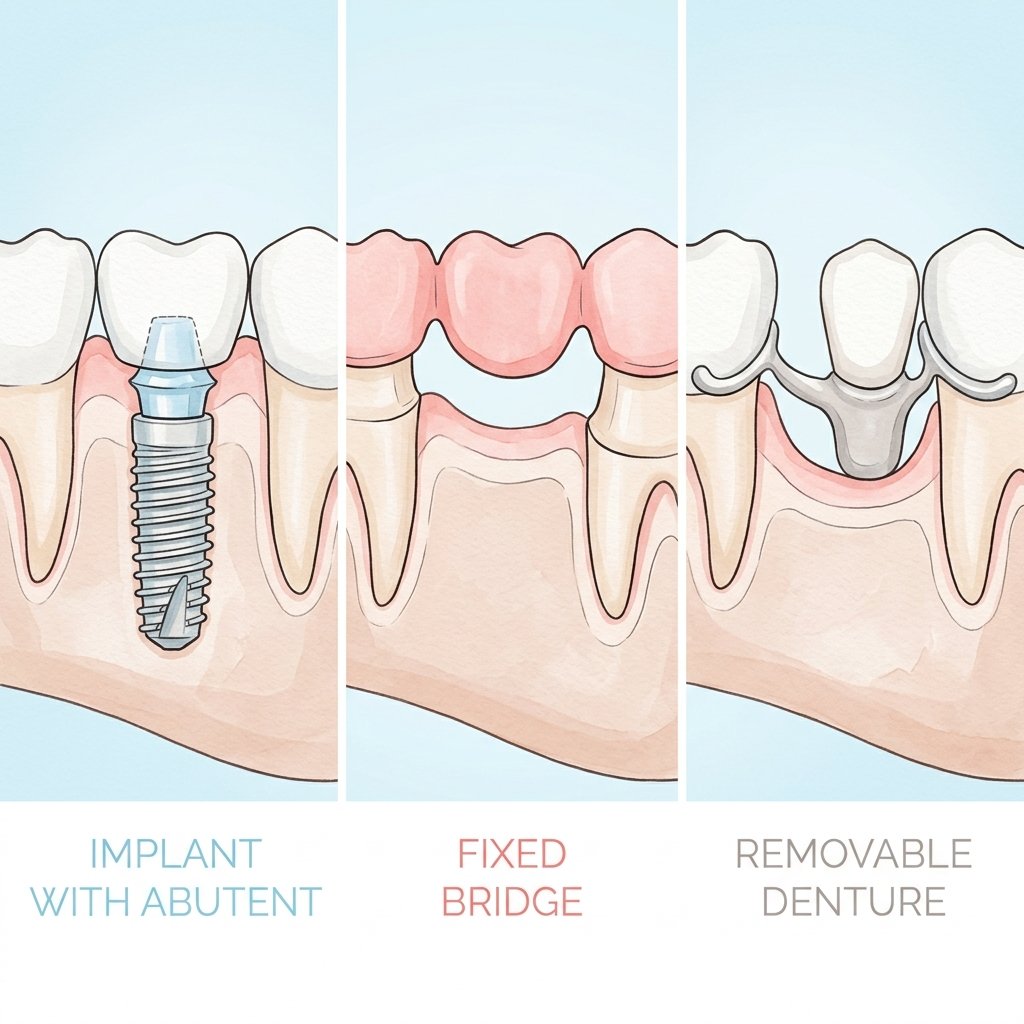
So you can make an honest comparison, here are the three main treatments measured against the criteria that matter most in the decision.
| Criterion | Implant | Fixed bridge | Removable denture |
|---|---|---|---|
| Average longevity | Decades (with maintenance) | 10–15 years | 5–8 years |
| Bone preservation | Yes | No | No |
| Adjacent teeth affected | No | Yes (grinding) | Partially (clasps) |
| Chewing function | Same as natural tooth | Good | Reduced |
| Upfront cost | High | Medium | Low |
| Cost-benefit over 20 years | Favorable | Medium | Unfavorable |
The longevity column is the one that most changes the economic analysis. A dental bridge that is replaced twice over twenty years can end up costing more than an implant that lasts a lifetime with periodic check-ups. This is real cost-benefit, not marketing.
When the implant is clearly the best option
There are patient profiles where the implant is not just preferable: it is the only solution that makes clinical sense in the medium term.
- Young or middle-aged patients with decades of use ahead. The time horizon means the initial investment pays for itself many times over.
- Loss of a single isolated tooth with healthy adjacent teeth. Grinding those teeth to place a dental bridge would mean sacrificing healthy tissue unnecessarily.
- Patients with good bone density and no systemic contraindications. Osseointegration is predictable and the success rate is high.
- People with high chewing demands or who play contact sports: the stability of the implant is unmatched.
In these cases, choosing the dental bridge to save money in the moment can be, paradoxically, the most expensive decision in the long run.
When a dental bridge or removable denture makes sense
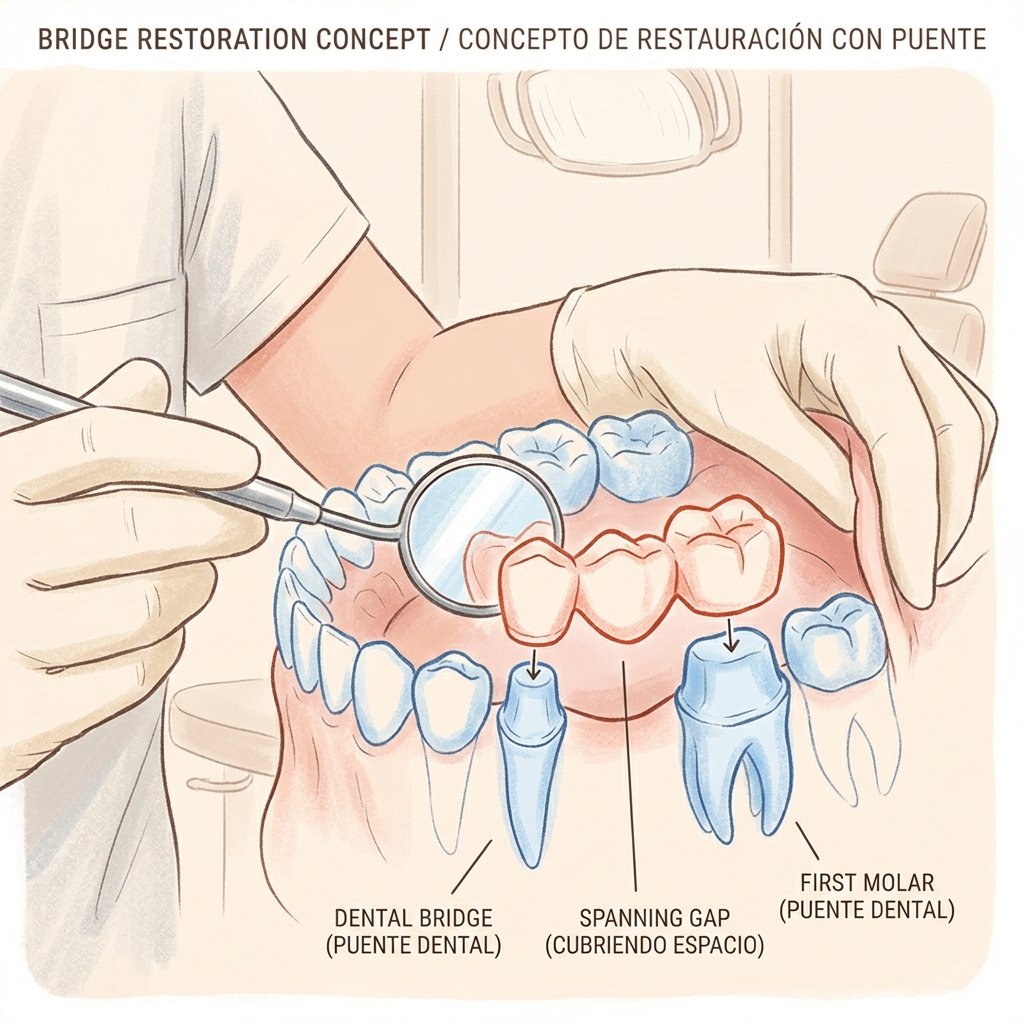
Here comes the honesty that distinguishes a good professional from one who only sells the most expensive treatment. There are situations where the implant is not the best option, or simply is not viable.
Real medical contraindications
Certain systemic conditions —poorly controlled diabetes, bisphosphonate treatment, radiotherapy in the maxillofacial area, severe immunosuppression— significantly increase the risk of implant failure. In these cases, the dental bridge is a clinically reasonable alternative and not a second-rate solution.
The same applies to patients with severe bone loss who do not want or cannot undergo prior bone regeneration. Without sufficient bone, the implant cannot osseointegrate.
Financial situations that require staged solutions
The clinical reality is simple: a treatment the patient cannot afford is not an option. If the budget does not allow for an implant right now, a well-executed dental bridge is infinitely better than leaving the space empty. Leaving the space empty is the serious mistake: it accelerates bone loss, encourages the adjacent teeth to shift toward the gap, and complicates any future solution.
At Clínicas dentales Platón we always assess the patient’s full context before proposing a plan. Sometimes that means designing a phased treatment that starts with a bridge and plans for the implant when circumstances allow.
The calculation nobody does for you: total cost over 20 years
When a patient compares the price of an implant with that of a dental bridge, they usually compare the upfront cost. That is the most common perspective error in the decision-making process.
A dental bridge has an average lifespan of ten to fifteen years. After that, it needs to be replaced. In that replacement, the abutment teeth —which were already ground down in the first procedure— may present secondary cavities, fractures, or the need for a root canal. The cost of the second procedure is not just the new bridge: it potentially includes treatment of the supporting teeth.
A removable denture, for its part, requires periodic relining and more frequent replacements, and the bone loss beneath the denture accelerates over time, requiring constant adjustments. Chewing function suffers, and with it quality of life and long-term nutrition.
The implant, with annual check-ups and proper hygiene, can last the rest of your life. That is the real cost-benefit calculation. Not the price on the day of the estimate.
Frequently asked questions
Does getting a dental implant hurt more than a dental bridge?
Implant placement is a minor surgery performed under local anaesthesia, so there is no pain during the procedure. Post-operative discomfort —swelling and sensitivity for a few days— is manageable with conventional pain relief. A dental bridge does not require surgery, but grinding the adjacent teeth can also cause temporary sensitivity. In terms of real discomfort, the difference is not as great as many patients fear.
How long does implant treatment take to complete?
The standard process includes implant placement, an osseointegration period of between two and six months depending on the case, and placement of the definitive crown. In some patient profiles, immediate loading is possible, which significantly shortens the timeline. Your clinic will advise you on which protocol is appropriate for your situation.
Is a dental bridge always worse than an implant?
No. In patients with contraindications for surgery, severe bone loss with no possibility of regeneration, or when the adjacent teeth already needed crowns anyway, a dental bridge is a clinically valid and reasonable solution. The key is that the decision is made by a professional with full information about the case, not by the price list.
What happens if I don’t replace the missing tooth?
Leaving the space empty is the worst option. The bone in that area begins to resorb immediately, the adjacent teeth tend to tilt toward the gap, and the opposing tooth may over-erupt. Over time, these changes complicate and increase the cost of any future solution. There is no comfortable third way: an empty space always causes problems.
{"@context":"https://schema.org","@type":"FAQPage","mainEntity":[{"@type":"Question","name":"Does getting a dental implant hurt more than a dental bridge?","acceptedAnswer":{"@type":"Answer","text":"\u003Cp\u003EImplant placement is a minor surgery performed under local anaesthesia, so there is no pain during the procedure. Post-operative discomfort —swelling and sensitivity for a few days— is manageable with conventional pain relief. A dental bridge does not require surgery, but grinding the adjacent teeth can also cause temporary sensitivity. In terms of real discomfort, the difference is not as great as many patients fear.\u003C/p\u003E"}},{"@type":"Question","name":"How long does implant treatment take to complete?","acceptedAnswer":{"@type":"Answer","text":"\u003Cp\u003EThe standard process includes implant placement, an osseointegration period of between two and six months depending on the case, and placement of the definitive crown. In some patient profiles, immediate loading is possible, which significantly shortens the timeline. Your clinic will advise you on which protocol is appropriate for your situation.\u003C/p\u003E"}},{"@type":"Question","name":"Is a dental bridge always worse than an implant?","acceptedAnswer":{"@type":"Answer","text":"\u003Cp\u003ENo. In patients with contraindications for surgery, severe bone loss with no possibility of regeneration, or when the adjacent teeth already needed crowns anyway, a dental bridge is a clinically valid and reasonable solution. The key is that the decision is made by a professional with full information about the case, not by the price list.\u003C/p\u003E"}},{"@type":"Question","name":"What happens if I don't replace the missing tooth?","acceptedAnswer":{"@type":"Answer","text":"\u003Cp\u003ELeaving the space empty is the worst option. The bone in that area begins to resorb immediately, the adjacent teeth tend to tilt toward the gap, and the opposing tooth may over-erupt. Over time, these changes complicate and increase the cost of any future solution. There is no comfortable third way: an empty space always causes problems.\u003C/p\u003E"}}]}