 Whatsapp


There are few pains as intense and desperate as a dental infection. It starts as a dull ache you think will go away on its own, but one night it wakes you up with a brutal throbbing deep inside your jaw. The next morning, your cheek is swollen, you can barely close your mouth, and ibuprofen barely scratches the surface of the pain. Welcome to the world of the dental abscess.
However, the most dangerous thing about a dental infection is not the pain itself (which is already terrible), but what many patients do next: they Google “antibiotic for tooth infection,” take the Amoxicillin left over from another time, notice some relief after two days… and forget about it. A very serious mistake.
The antibiotic can temporarily reduce the bacterial load, but it does not eliminate the source of the infection. It is like turning off the fire alarm without putting out the fire. The infection is still there, lying in wait, and it will return — almost always worse — in weeks or months. In the most serious cases, it can spread to deep spaces in the neck, block the airway, or cause sepsis (a generalized infection in the bloodstream).
In this article we are going to explain how a dental infection really progresses from an innocent cavity to a hospital emergency, what types exist, what symptoms should make you run to the dentist, and above all, what real treatments exist (spoiler: antibiotics alone are never the solution).
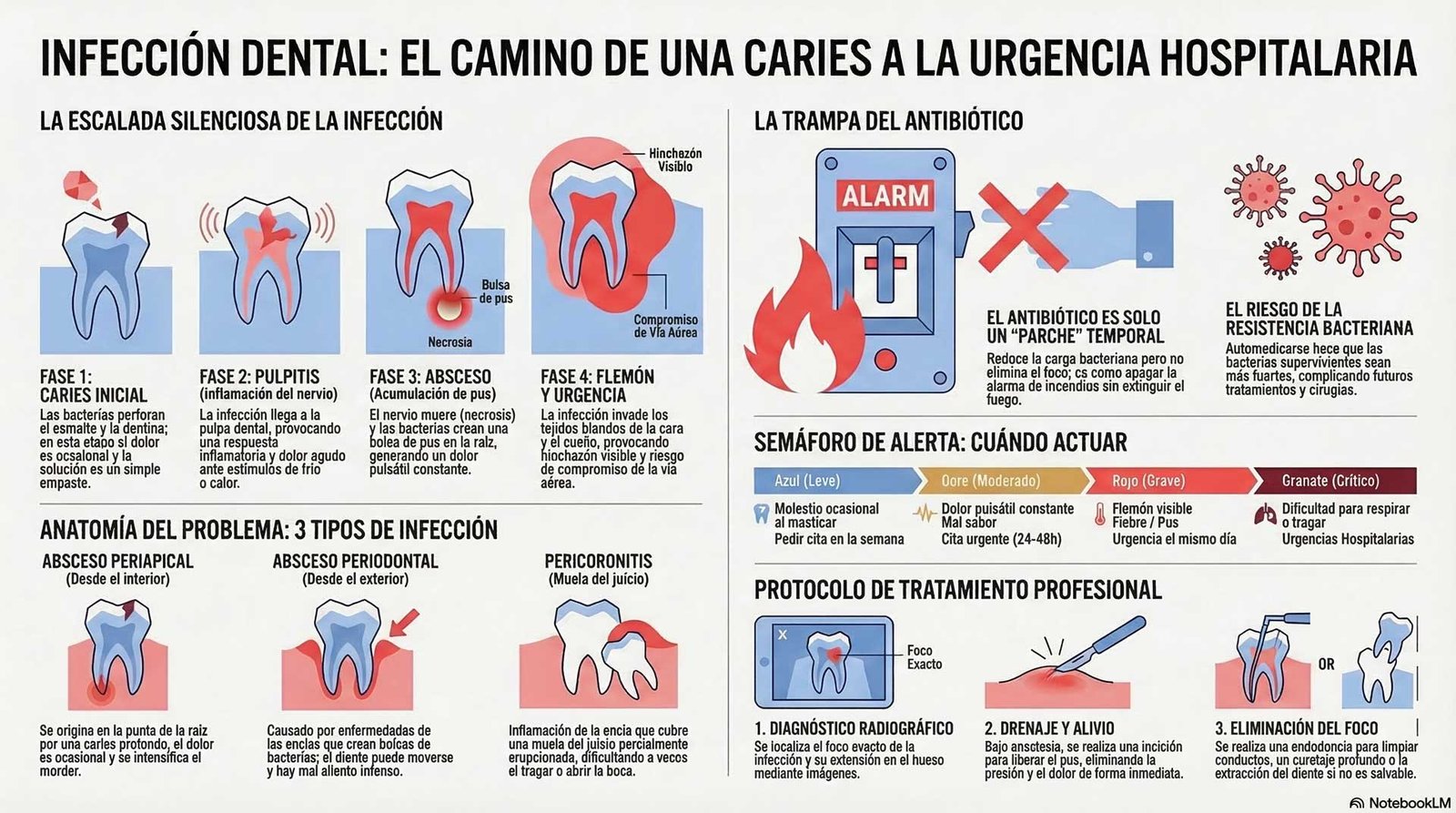
FROM CAVITY TO EMERGENCY: THE SILENT ESCALATION 1. CAVITY Enamel/dentin only No constant pain 2. PULPITIS Inflamed nerve Pain with cold/heat 3. ABSCESS PUS Pus at the root Throbbing pain 24h 4. PHLEGMON SWELLING Invades soft tissues EMERGENCY
Anatomy of a dental infection: How does a cavity turn into an abscess?
To understand why a dental infection can ruin your week (or put you in danger), you need to visualize the internal architecture of your tooth. We have explained this in previous articles, but here we are going to connect the pieces with the infection.
Your tooth has three layers. The outer one is the enamel, hard and insensitive. Beneath it is the dentin, porous and sensitive. And deep in the center lives the pulp: a soft tissue full of blood vessels and nerves. The pulp is the “heart” of the tooth.
When a cavity advances without treatment, bacteria perforate the enamel, cross the dentin, and reach the pulp. At that point the nerve becomes inflamed (pulpitis). If it is still reversible, a deep filling or pulp protection can save the situation. But if the infection advances, the nerve dies (pulp necrosis) and bacteria colonize the entire canal system of the tooth.
And what do bacteria do when they run out of space inside the tooth? They look for a way out. They push through the apex (the tip of the root) and settle in the bone surrounding the tooth, creating a pocket of pus: the dreaded periapical abscess.
Pus is pressure. And pressure is pain. A throbbing, constant pain that beats with your heart and does not let you sleep. If the body manages to create a natural drainage channel (the well-known “fistula,” that little bump on the gum that oozes), the pain can temporarily decrease. Many patients interpret this as “it healed on its own.” No. Your body is managing an emergency, not resolving it.
When faced with a dental infection, it is best to see a professional as soon as possible; at our dental clinic in Palma we treat these types of cases.
The 3 types of dental infection you should know about
Not all dental infections are the same. Depending on where the problem originates, the approach is completely different. In the clinic, the three we see most frequently are:
- Periapical abscess (the “inside” infection) It is the most common. The infection starts from inside the tooth (deep cavity, a blow that killed the nerve, an old root canal that has failed) and settles at the tip of the root.
- Where does it hurt? In the tooth itself. Localized pain you can point to with your finger.
- Key sign: Pain when biting or gently tapping the affected tooth. Sometimes a small “bump” of pus appears on the gum just above the root.
- Periodontal abscess (the “outside” infection) Here the origin is not the cavity, but gum disease. When periodontitis advances, deep pockets form between the gum and the tooth where bacteria accumulate. If a pocket becomes blocked, the pus becomes trapped and the abscess forms.
- Where does it hurt? More in the gum than in the tooth. The area is red, swollen, and may bleed or ooze.
- Key sign: The tooth may be healthy inside but move slightly. Intense and persistent bad breath.
- Pericoronitis (wisdom tooth infection) It occurs when a wisdom tooth partially erupts and remains covered by a flap of gum. Food gets trapped under that flap, bacteria proliferate, and the gum becomes infected and inflamed.
- Where does it hurt? In the back area of the jaw. It can radiate to the ear, the throat, and even make swallowing difficult.
- Key sign: Difficulty opening the mouth fully (trismus) and pain when swallowing.
.inf-types { display: flex; flex-wrap: wrap; gap: 20px; margin: 30px 0; font-family: sans-serif; } .inf-card { flex: 1; min-width: 280px; border-radius: 12px; overflow: hidden; box-shadow: 0 4px 10px rgba(0,0,0,0.06); background: white; border: 1px solid #dce1e3; } .inf-head { padding: 15px; color: white; text-align: center; font-weight: bold; text-transform: uppercase; font-size: 0.95rem; letter-spacing: 1px; } .head-periapical { background: #c0392b; } .head-periodontal { background: #5b9bd5; } .head-pericoronitis { background: #7d8a96; } .inf-body { padding: 20px; text-align: center; } .inf-label { font-size: 1.1rem; font-weight: 800; color: #2c3e50; margin-bottom: 12px; display: block; } .inf-desc { font-size: 0.95rem; color: #555; line-height: 1.5; margin-bottom: 15px; } .inf-risk { font-size: 0.85rem; font-weight: bold; color: #2c3e50; background: #f0f2f4; padding: 8px; border-radius: 6px; } Periapical Abscess Root infection
The infection originates at the tip of the root. Caused by untreated deep cavities that reach the nerve.
Main cause: NEGLECTED CAVITY Periodontal Abscess Gum infection
Pus forms in the pockets between the gum and the tooth. Linked to advanced periodontitis (pyorrhea).
Main cause: GUM DISEASE Pericoronitis Wisdom tooth infection
The gum covering a poorly erupted wisdom tooth becomes infected. Very common between the ages of 18 and 30.
Main cause: IMPACTED WISDOM TOOTH
Symptoms of a dental infection: your body warns you before the emergency
A dental infection does not appear overnight. There is a progressive escalation of signs, and each phase gives you the opportunity to act before the situation gets complicated. The problem is that most patients only react in phase 3 or 4, when the pain is already unbearable.
Here is the “traffic light” of dental infection. Identify which phase you are in and act accordingly:
.infection-gauge { background: #f7f8f9; border: 1px solid #dce1e3; border-radius: 12px; padding: 30px; margin: 30px 0; font-family: sans-serif; box-shadow: 0 4px 12px rgba(0,0,0,0.04); } .ig-title { text-align: center; font-weight: 800; color: #2c3e50; margin-bottom: 25px; font-size: 1.2rem; text-transform: uppercase; letter-spacing: 1px; } .ig-row { display: flex; align-items: center; margin-bottom: 15px; padding: 15px; border-radius: 10px; background: white; } .ig-row:last-child { margin-bottom: 0; } .lvl-1 { border-left: 6px solid #5b9bd5; } .lvl-2 { border-left: 6px solid #d4a574; } .lvl-3 { border-left: 6px solid #d98880; } .lvl-4 { border-left: 6px solid #922b21; } .ig-phase { font-weight: 800; font-size: 1.4rem; margin-right: 20px; min-width: 50px; text-align: center; color: #aab7b8; } .ig-info h4 { margin: 0 0 5px 0; font-size: 1rem; font-weight: bold; } .ig-info p { margin: 0; font-size: 0.9rem; color: #555; } .ig-tag { display: inline-block; font-size: 0.75rem; font-weight: bold; text-transform: uppercase; padding: 3px 8px; border-radius: 4px; margin-top: 5px; background: #f7f8f9; border: 1px solid #dce1e3; } Dental Infection Traffic Light: When to Act 1 Mild discomfort
Occasional pain when chewing or with cold. The tooth may have a visible cavity.
Action: Book an appointment this week 2 Constant pain
Throbbing pain that does not ease with painkillers. Extreme sensitivity to heat. Possible bad taste.
Action: Urgent appointment within 24-48h 3 Visible swelling
Swelling on the face or gum. Small “bump” of pus next to the tooth. Fever. Difficulty opening the mouth.
Action: EMERGENCY the same day 4 Warning signs
High fever (+38.5°C), swelling spreading down the neck, difficulty swallowing or breathing, intense general malaise.
Action: HOSPITAL EMERGENCY (do not wait)
Other associated symptoms you should not overlook:
- Persistent bitter or salty taste: Indicates that the abscess is draining pus into the mouth.
- Bad breath that does not go away with brushing: The bacteria from the infection produce foul-smelling gases.
- Swollen lymph nodes under the jaw or in the neck: Your immune system is fighting the infection.
- Tooth that “feels higher” when biting: The pressure of the pus at the root pushes the tooth upward.
The big trap: "I took an antibiotic and it went away"
If we had to choose the most dangerous phrase we hear in the clinic, it would be this one. And we hear it every week.
Let us be direct: antibiotics do not cure a dental infection. Full stop. They can control it temporarily, they can reduce the inflammation enough for you to stop having a fever, they can give you a false sense that “it’s over.” But the source of the infection (the cavity that reached the nerve, the infected periodontal pocket, the impacted wisdom tooth) remains intact.
What really happens when you self-medicate?
- First round: The antibiotic reduces the bacterial load. You feel better in 48-72 hours. You think: “See? There was no need to go to the dentist.”
- Weeks later: The surviving bacteria (the most resistant ones) start multiplying again. The pain returns, often worse. You take another course of antibiotics.
- The vicious cycle: It works less and less each time. Bacteria develop resistance. What started as a treatable abscess with a simple root canal can end up as an infection requiring extraction, surgery, or hospital admission.
.automed-vs { display: flex; flex-wrap: wrap; gap: 20px; margin: 30px 0; font-family: sans-serif; } .am-card { flex: 1; min-width: 280px; padding: 25px; border-radius: 12px; text-align: center; box-shadow: 0 4px 10px rgba(0,0,0,0.05); position: relative; border: 1px solid #dce1e3; } .card-bad { background-color: #f2d7d5; border-top: 5px solid #d98880; } .bad-label { font-size: 0.75rem; text-transform: uppercase; letter-spacing: 1px; color: #922b21; font-weight: 800; display: block; margin-bottom: 8px; } .bad-title { color: #922b21; font-weight: 800; font-size: 1.2rem; margin-bottom: 10px; text-decoration: line-through; } .card-good { background-color: #d6eaf8; border-top: 5px solid #5b9bd5; transform: scale(1.02); box-shadow: 0 8px 20px rgba(91, 155, 213, 0.12); } .good-label { font-size: 0.75rem; text-transform: uppercase; letter-spacing: 1px; color: #2c5f8a; font-weight: 800; display: block; margin-bottom: 8px; } .good-title { color: #2c5f8a; font-weight: 800; font-size: 1.3rem; margin-bottom: 10px; } .am-desc { font-size: 0.95rem; color: #555; line-height: 1.5; margin-bottom: 15px; } .am-badge { display: inline-block; padding: 5px 15px; border-radius: 20px; font-weight: bold; font-size: 0.85rem; color: white; } .badge-fail { background: #aab7b8; } .badge-win { background: #5b9bd5; } What you should NOT do Self-medicating with antibiotics
Taking Amoxicillin “on your own” can temporarily mask the symptoms, but does not eliminate the cause. In addition, you generate bacterial resistance.
Dangerous What DOES work Clinic treatment
The dentist locates the source, drains the pus if present, and treats the real cause (root canal, deep cleaning, or extraction). The antibiotic only complements, never replaces.
The only real solution
When a dental infection becomes complicated: from phlegmon to hospital
Let us talk about the scenario nobody wants to experience but that exists and that we see in emergency rooms more than we would like. A dental infection that is not treated can escape the tooth and spread through the anatomical spaces of the face and neck. And that is when things get serious.
The phlegmon: This is the colloquial name for facial cellulitis of dental origin. The infection spreads from the bone into the soft tissues of the cheek, creating a hard, hot, and painful swelling that can close the eye or deform the face. It requires surgical drainage under anesthesia and intravenous antibiotics.
Ludwig’s angina: This is the most feared complication. The infection, generally originating in the lower molars, spreads to the floor of the mouth (the space beneath the tongue). The tongue swells and is pushed upward and backward, compromising the airway. It is a medical emergency that may require intubation or emergency tracheotomy. Before modern antibiotics, mortality exceeded 50%. Today it is around 8% with adequate treatment, but it remains potentially fatal.
Sepsis: If bacteria reach the bloodstream, the body triggers a massive inflammatory response that can lead to multi-organ failure. Warning signs are persistent high fever, mental confusion, tachycardia, and difficulty breathing. In the presence of these symptoms, you must go to a hospital emergency room immediately, without waiting for the dentist.
Does this seem exaggerated? These scenarios are not medical fiction. They are documented consequences of neglected dental infections. The vast majority could have been avoided with a simple timely visit to the dentist.
How is a dental infection really treated at the clinic?
We come to the part that interests most: what is the dentist going to do? Do not worry, the protocol is standardized and, with modern anesthesia, it is much less traumatic than you imagine.
.treat-card { background: #fff; border: 2px solid #5b9bd5; border-radius: 15px; padding: 0; margin: 30px 0; font-family: sans-serif; overflow: hidden; box-shadow: 0 5px 15px rgba(91, 155, 213, 0.1); } .treat-header { background: #5b9bd5; color: white; padding: 15px; text-align: center; font-weight: 800; font-size: 1.2rem; text-transform: uppercase; letter-spacing: 1px; } .treat-steps { display: flex; flex-direction: column; } .treat-step { display: flex; padding: 20px; border-bottom: 1px dashed #dce1e3; align-items: flex-start; } .treat-step:last-child { border-bottom: none; } .t-num { background: #d6eaf8; color: #5b9bd5; font-weight: bold; width: 35px; height: 35px; border-radius: 50%; display: flex; align-items: center; justify-content: center; margin-right: 15px; flex-shrink: 0; font-size: 1.1rem; } .t-text h4 { margin: 0 0 5px 0; color: #2c3e50; font-size: 1.05rem; } .t-text p { margin: 0; font-size: 0.95rem; color: #555; line-height: 1.5; } .t-cue { display: inline-block; background: #f0f2f4; padding: 2px 8px; border-radius: 4px; font-size: 0.8rem; font-weight: bold; color: #5d6d7e; margin-top: 5px; border: 1px solid #dce1e3; } What the dentist will do: Protocol for a Dental Infection 1 Diagnosis and X-ray
Locate the exact source: is it the root, the gum, a wisdom tooth? A periapical or panoramic X-ray shows the extent of the infection in the bone.
10-15 min 2 Drainage (if pus has accumulated)
Local anesthesia is applied and an incision is made to drain the abscess. Relief is immediate: the pressure disappears and the pain drops drastically.
With anesthesia, it does not hurt 3 Treatment of the Cause
Depending on the origin: Root canal (cleaning the nerve + sealing the canals), curettage (deep cleaning of periodontal pockets), or extraction if the tooth cannot be saved.
Eliminate the source, not just the symptom 4 Complementary Medication
Antibiotic only if the dentist prescribes it (not always necessary). Anti-inflammatory and painkiller as directed. Postoperative hygiene instructions.
Follow the instructions to the letter
Important note about root canal treatment: Many patients are terrified of “killing the nerve.” The truth is that, when the nerve is already infected or dead, the root canal does not “kill” anything: it cleans tissue that no longer functions and seals the canals so that bacteria cannot colonize them again. With adequate anesthesia, the procedure is painless. What does hurt is not doing it.
How to prevent a dental infection (the easy part that nobody does)
Preventing a dental infection is no mystery. But it requires consistency, which is exactly where we all fall short. Here are the real keys:
- Do not ignore cavities. The number one cause of dental infection is a cavity that was put off until “next month” for two years. A small cavity is resolved with a 30-minute filling. A cavity that reaches the nerve needs a root canal. And a resulting infection may need surgery. The equation is simple.
- Brush and floss, without negotiation. The bacteria that cause the infection are the same ones that live in plaque. Brushing twice a day (minimum) + flossing once a day. It is not optional.
- Check-ups every 6 months. The dentist detects problems you cannot see or feel. A routine X-ray can reveal a silent infection at the root of a tooth that does not even hurt yet.
- If you take a blow to a tooth, go to the dentist even if it does not hurt. A trauma can silently kill the nerve. The tooth darkens over time and, by the time it starts to hurt, the infection is already established.
- Control gum disease. If your gums bleed when you brush, do not normalize it. Bleeding is synonymous with inflammation, and chronic gum inflammation (periodontitis) is the second major gateway to serious dental infections.

In summary: a dental infection does not wait, and neither should you
If anything should be clear to you after reading this article, it is that a dental infection never resolves on its own. It may give temporary relief, it may seem to improve with an antibiotic, it may stop hurting temporarily if the abscess drains on its own. But the source is still there, the bacteria are still multiplying, and the damage to the bone continues to advance in silence.
The good news is that, detected in time, a dental infection is resolved with predictable, painless treatments with very high success rates. A well-performed root canal can save a tooth for decades. An abscess drainage provides immediate relief. Even an extraction, when necessary, eliminates the problem at its root (literally) and opens the door to a clean rehabilitation.
The bad news is that every day that passes without treatment, the options shrink and the risks increase. Do not play roulette with your mouth: a 30-euro cavity can turn into a surgery costing thousands if you let it escalate.
Frequently asked questions about dental infection
.faq-section { background: #f7f8f9; border: 1px solid #dce1e3; border-radius: 12px; padding: 30px; margin: 30px 0; font-family: sans-serif; } .faq-title { text-align: center; font-weight: 800; color: #2c3e50; font-size: 1.2rem; margin-bottom: 25px; text-transform: uppercase; letter-spacing: 1px; } .faq-item { background: white; border-radius: 8px; padding: 20px; margin-bottom: 15px; border-left: 4px solid #5b9bd5; box-shadow: 0 2px 4px rgba(0,0,0,0.03); } .faq-item:last-child { margin-bottom: 0; } .faq-q { font-weight: 800; color: #2c5f8a; font-size: 1.05rem; margin-bottom: 8px; } .faq-a { font-size: 0.95rem; color: #555; line-height: 1.6; } .faq-a strong { color: #2c3e50; } .faq-highlight { display: inline-block; background: #d6eaf8; padding: 2px 6px; border-radius: 3px; font-weight: bold; color: #2c5f8a; font-size: 0.9rem; } Frequently asked questions Can a dental infection heal on its own? No. The body can temporarily contain the infection (by forming a fistula that drains pus), but it
never eliminates it. The cause (deep cavity, periodontal pocket, dead nerve) remains intact. Without dental treatment, the infection always returns and, in many cases, more aggressively. Can I take an antibiotic without going to the dentist? It is one of the most common and dangerous mistakes. The antibiotic can temporarily relieve the symptoms, but
does not treat the cause of the infection. In addition, self-medication generates bacterial resistance. Antibiotics should only be taken under the dentist's prescription and always as a complement to clinical treatment, never as a substitute. How long does it take for a dental infection to become dangerous? There is no fixed timeframe. Some infections remain chronic and latent for months. Others can spread to deep tissues of the neck in
a matter of days, especially in patients with diabetes, immunocompromised individuals, or smokers. The general rule: if you have constant throbbing pain, facial swelling, or fever, do not wait more than 24 hours to seek advice. Is it normal for a dental infection to cause fever? Yes. Fever indicates that the infection has gone beyond the local area of the tooth and your immune system is responding in a generalized way.
Fever above 38°C associated with dental pain is a reason for urgent consultation.If it exceeds 38.5°C or is accompanied by difficulty swallowing, you should go to a hospital emergency room. What is the difference between an abscess and a phlegmon? An
abscessis the accumulation of pus at a specific point, normally at the tip of the tooth root or in the gum. A
phlegmon(facial cellulitis) appears when that infection escapes from the bone and spreads to the soft tissues of the face (cheek, jaw). The phlegmon represents a more advanced stage and requires more aggressive treatment. Can a dental infection affect the heart or other organs? Yes, although it is uncommon. If bacteria from a dental abscess reach the bloodstream, they can reach distant organs. The most documented complication is
bacterial endocarditis(infection of the heart valves), especially in patients with pre-existing heart conditions. Brain abscesses and pneumonia of dental origin have also been described. These are extreme cases, but real ones. I had a root canal and it still hurts. Is that normal? Mild pain or discomfort when biting during
the first 1-2 weeksafter a root canal is normal. It is residual inflammation of the tissue surrounding the root. However, if the pain is intense, throbbing, accompanied by swelling, or does not improve after 2-3 weeks, contact your dentist. There may be an unlocated canal or a crack in the root. Does ibuprofen help with a dental infection? Ibuprofen is an
anti-inflammatory and painkiller, not an antibiotic. It can help you control the pain and inflammation while you wait for your dentist appointment, but it does not fight the infection itself. It is a useful temporary fix, not a solution. If you need more than 2-3 days of ibuprofen for dental pain, you need professional treatment.