 Whatsapp


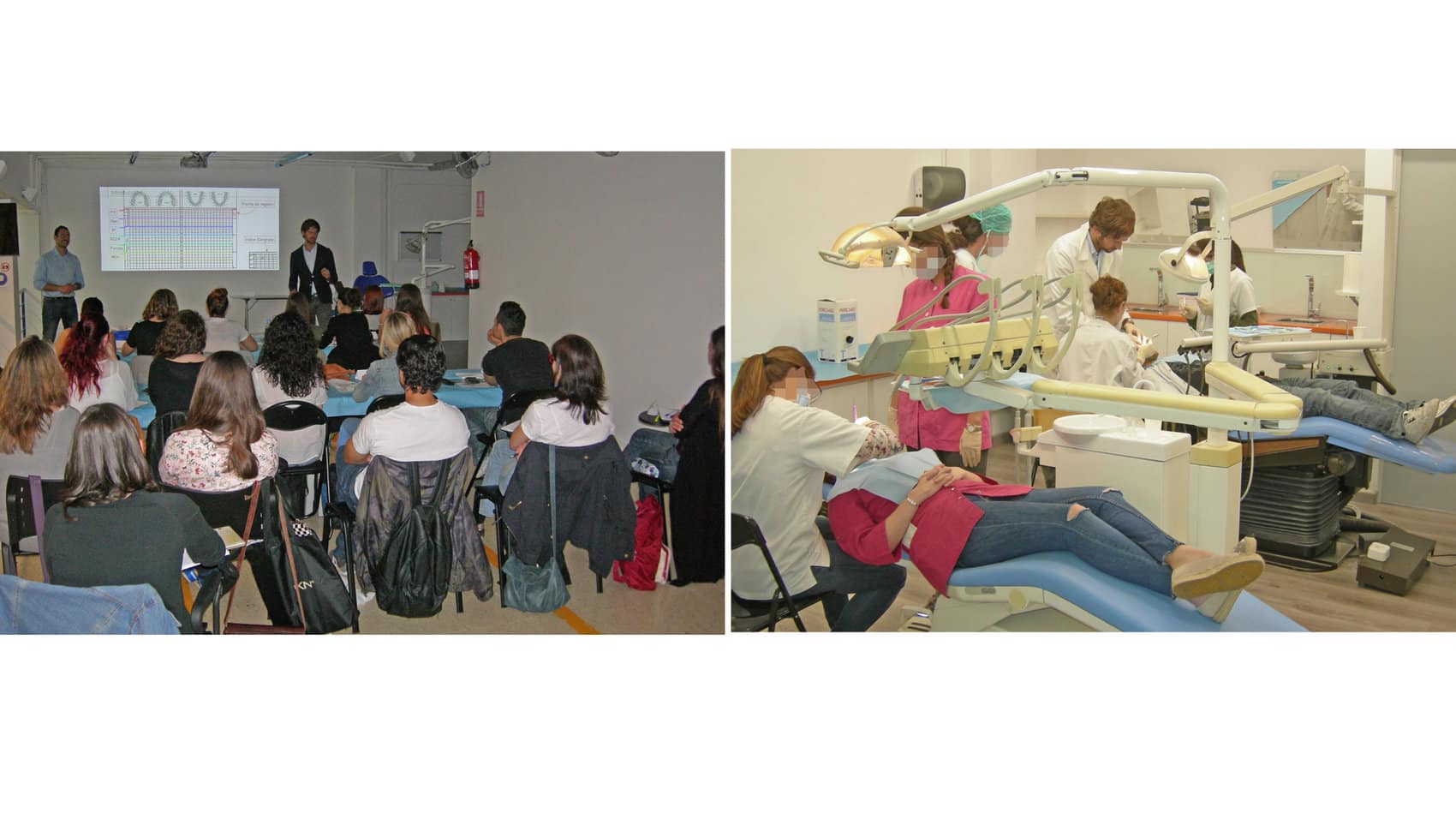 You have had the implant for three years and it has never given you any trouble. Until one day you notice that your gum bleeds when you brush. You put it down to the toothbrush, to being in a rush, to anything but the implant. After all, “the implant is made of titanium, it cannot get sick.” That belief, as widespread as it is dangerous, is precisely the starting point from which Dr. Platón built his lecture for the professionals of AHIADEC. Because dental implants do not get sick, but the tissues surrounding them do. And when they do, it is called peri-implantitis.
A theoretical-practical session at AHIADEC
On 1 October, Dr. Platón participated as a speaker in a course organised by the Associació d’Higienistes i Auxiliars Dentals de Catalunya (AHIADEC), held at the association’s own premises. AHIADEC is the professional reference body for dental hygienists and dental assistants in Catalonia, a key group in the early detection of periodontal and implant disease. The fact that an association of this profile invites Dr. Platón to deliver advanced clinical training is, in itself, a recognition of his career.
During the session, which was theoretical-practical in nature, the doctor from Platón Dental — together with Dr. Puglisi — addressed from different perspectives the existing options for the treatment of periodontal problems. Both highlighted the risk factors in peri-implantitis and the preventive methods available to us to maintain the health of patients who have implants.
Peri-implantitis: what it is and why it matters
Peri-implantitis is a bacterial infection that affects the tissues surrounding a dental implant: the gum and, in more advanced stages, the bone that supports it. Its mechanism is similar to that of classic periodontitis, but with some particularities that make it more aggressive and, at times, more difficult to treat. According to data from the Spanish Society of Periodontics (SEPA), it is estimated that between 10 and 20% of placed implants will develop some degree of peri-implantitis over their useful life.
The European Federation of Periodontology (EFP) also points out that the actual prevalence of peri-implantitis could be even higher, given that many cases are diagnosed late, when bone loss is already significant. Hence the importance of dental hygienists and dental assistants — the professionals who most frequently carry out maintenance check-ups — being trained to detect the first warning signs. Dr. Platón insists that this training is one of the fundamental pillars for reducing the incidence of the disease.
What are the symptoms of peri-implantitis?
One of the major problems with peri-implantitis is that it progresses silently. In its initial phases — when we are still dealing with implant mucositis — the symptoms are subtle and easy to ignore. Knowing how to recognise them in time makes the difference between a simple treatment and a complex one.
Signs of implant mucositis (reversible phase, without bone loss):
- Bleeding when brushing or using floss around the implant, without apparent pain.
- Reddened or slightly inflamed gum in the area of the implant.
- Sensation of localised swelling that comes and goes.
Signs of established peri-implantitis (with progressive bone loss):
- Spontaneous bleeding without the need to brush, or visible suppuration around the implant.
- Implant mobility: if the implant moves even slightly, bone loss is already advanced.
- Pain under pressure or when chewing in the area of the implant.
- Persistent bad taste or halitosis that does not improve with regular hygiene.
- Visible gum recession, with exposure of part of the implant surface.
If you recognise any of these signs, do not wait for your next scheduled check-up: call your clinic. The difference between mucositis and established peri-implantitis is, literally, the difference between debridement and surgery.
Risk factors you should know
Not all patients have the same risk of developing peri-implantitis. During the session, Dr. Platón and Dr. Puglisi reviewed the main factors that increase the likelihood of an implant becoming affected:
- History of periodontitis: patients who have suffered from periodontitis have a greater genetic and immunological predisposition to developing peri-implant infections.
- Smoking: tobacco compromises the vascularisation of gingival tissue and reduces the local immune response, favouring bacterial colonisation around the implant and increasing the risk of peri-implantitis.
- Poorly controlled diabetes: elevated blood glucose levels alter the capacity for healing and the inflammatory response, two critical factors for implant stability.
- Poor oral hygiene: the accumulation of bacterial biofilm (plaque) at the interface between the implant and the gum is the most frequent direct trigger of peri-implantitis.
- Absence of professional maintenance: skipping periodic check-ups prevents the timely detection of implant mucositis — the reversible phase prior to peri-implantitis — and stopping its progression.
- Inadequate prosthetic design: prostheses that hinder interdental hygiene or generate occlusal overloads are an underestimated but relevant risk factor.
Debunking myths about dental implants
In the clinic, Dr. Platón encounters the same mistaken beliefs time and again. Debunking these myths is not a rhetorical exercise: it is pure clinical practice, because a poorly informed patient stops attending check-ups and arrives late when the problem is already serious.
“Implants do not need care because they are made of titanium.” False. Titanium does not decay or break, but the gum and bone surrounding it are living tissue and can become infected in exactly the same way as around a natural tooth. Peri-implantitis does not attack the implant: it attacks the environment that supports it.
“If it does not hurt, the implant is fine.” This is perhaps the most dangerous belief. Peri-implantitis is, in its early phases, completely painless. When pain appears, bone loss is usually already significant and treatment becomes more complicated. The absence of pain is not a diagnosis: it is an invitation not to let your guard down.
“Implants last a lifetime without any further effort.” A well-placed and well-maintained implant can last for decades, yes. But “well-maintained” implies regular check-ups, specific interdental hygiene and control of risk factors. Without that maintenance, both the useful life of the implant and the risk of peri-implantitis are significantly compromised.
Prevention: maintenance protocol and frequency of check-ups
The good news is that peri-implantitis is, to a large extent, preventable. The key lies in combining rigorous home hygiene with a professional maintenance protocol adapted to each patient’s risk profile. At Platón Dental we follow the recommendations of SEPA and the EFP, which Dr. Platón applies by establishing personalised check-ups according to each patient’s risk.
| Risk profile | Check-up frequency | Determining factors |
|---|---|---|
| Low risk | Every 6 months | No history of periodontitis, non-smoker, controlled or absent diabetes, good oral hygiene |
| Moderate-high risk | Every 3-4 months | History of periodontitis, active smoking, poorly controlled diabetes, poor hygiene or complex prosthetic design |
At each maintenance visit, the hygienist evaluates the condition of the peri-implant tissues by probing, records pocket depth and detects possible signs of bleeding or suppuration. If mucositis is identified — inflammation without bone loss — treatment is relatively straightforward: professional debridement and reinforcement of interdental hygiene. If bone loss has already begun, the approach becomes more complex and may require resective surgery, regenerative techniques or the use of local antibiotics, as Dr. Platón explains in detail to his patients before beginning any intervention against peri-implantitis.
As for home hygiene, patients with implants must pay special attention to interdental cleaning. The interdental brush, the oral irrigator and, in some cases, PTFE floss specifically designed for implants are essential tools that a conventional toothbrush cannot replace. Poor interdental hygiene is, together with the lack of check-ups, the most frequent cause of peri-implantitis in patients who have already had their implants for years.
Dr. Platón's role as a reference in Periodontics and Implants
Dr. Platón‘s participation in this session is not an isolated event. A specialist in Periodontics and Implants from the Universitat Internacional de Catalunya (UIC) and a member of the Spanish Society of Periodontics (SEPA), Dr. Platón combines his clinical activity at Platón Dental with his teaching role in the Master’s in Periodontics and Implants at UIC. This dual dimension — clinical and academic — allows him to bring to his lectures not only the latest theory on peri-implantitis, but also the real cases he sees every week in the clinic.
A further demonstration that Dr. Platón intends to continue sharing his knowledge with other professionals in the field. A circumstance that also highlights the clear commitment we make from our clinics to continuing education as a guarantee of quality care.
Do you have implants and want to know if they are healthy?
If you have dental implants and it has been more than six months since your last maintenance check-up, now is the time to plan one. Early detection of implant mucositis can save you a much more complex — and costly — treatment in the future. At Platón Dental we carry out complete periodontal and implant check-ups, with the same clinical rigour that Dr. Platón conveys in his lectures for other professionals. If you have any questions about peri-implantitis or about the condition of your implants, do not hesitate to contact us.
Frequently asked questions
What is AHIADEC and why is it relevant that Dr. Platón delivered a lecture there?
AHIADEC (Associació d’Higienistes i Auxiliars Dentals de Catalunya) is the professional reference body for dental hygienists and dental assistants in Catalonia. The fact that it invites an external specialist such as Dr. Platón to train its members in periodontics and implantology is a direct recognition of his clinical authority in the field.
When is an implant considered to have peri-implantitis?
Peri-implantitis is diagnosed when there is inflammation of the peri-implant tissues accompanied by progressive bone loss around the implant. The previous phase — implant mucositis — presents only with gingival inflammation, without bone loss, and is reversible with appropriate treatment.
How often should I attend check-ups if I have dental implants?
The SEPA and EFP guidelines, which Dr. Platón follows in his clinical practice, recommend check-ups every six months for low-risk patients and every three or four months for patients with a history of periodontitis, smoking or other risk factors. Your periodontics specialist will determine the most appropriate frequency for your case.
Is peri-implantitis curable?
In early stages (mucositis), it is completely reversible. Once bone loss has occurred, treatment aims to halt progression and regenerate the lost bone as far as possible, but full recovery depends on the extent of the damage and the patient’s profile.