 Whatsapp


How does your dentist know that the implant is ready to support the crown? It is not intuition or experience by eye: it is science measurable in less than two seconds. At Platón Dental we use the Osstell® ISQ system to obtain an objective data point before making any decision about when and how to restore your implant. In this article we explain what it is, how it works and why it makes a difference in your treatment.
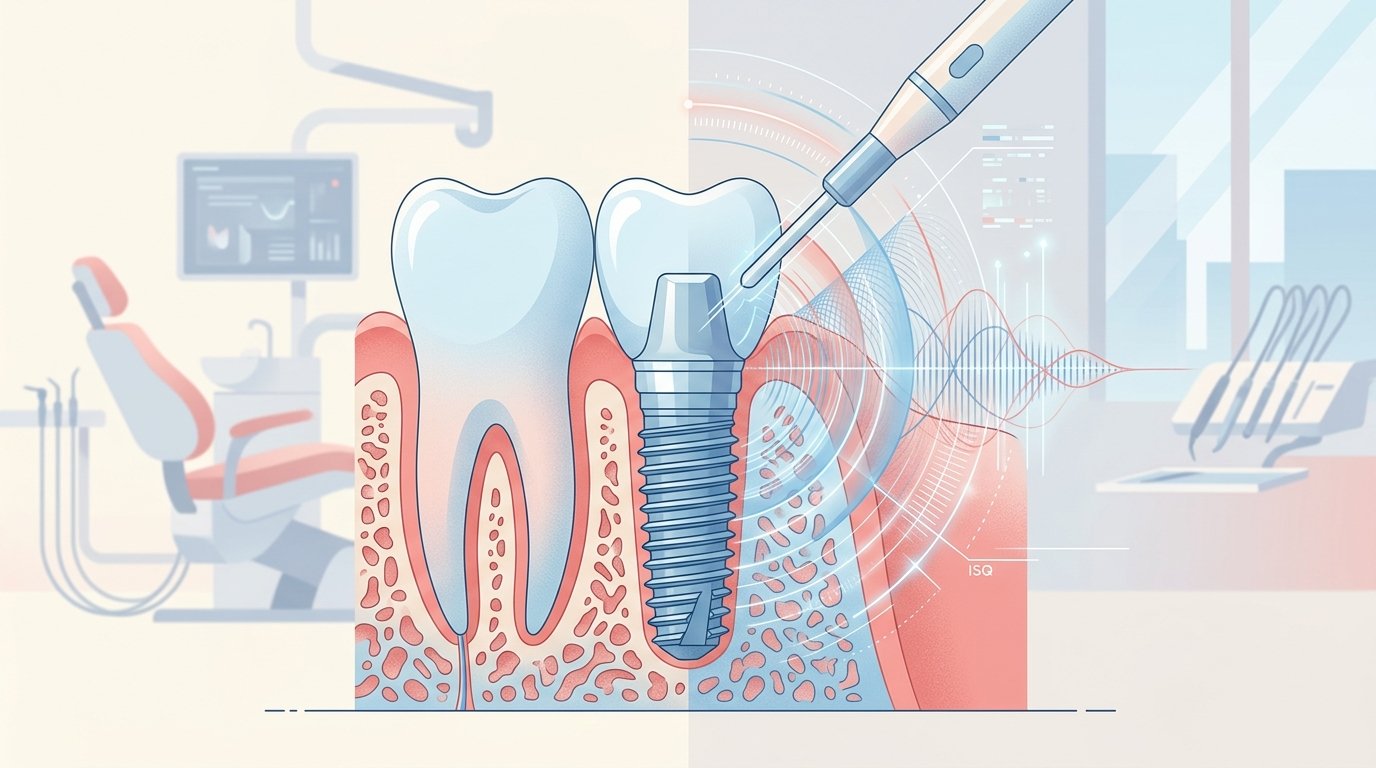
What is Osstell and why is it the world reference?
Osstell is a Swedish company that has spent more than two decades developing technology to evaluate the stability of dental implants in a non-invasive way. Its system, based on resonance frequency analysis (RFA), has become the international clinical standard: with more than 1,000 published scientific studies supporting its technology, Osstell has worked from the very beginning with an evidence-based approach, continuously reviewing research to improve its proprietary technology.
What makes Osstell special is not only the precision of the device, but the common language it has created among clinicians worldwide: the ISQ (Implant Stability Quotient) value. Thanks to this universal indicator, any implantology specialist can compare results, follow protocols and make decisions based on real data, not assumptions.
What does the ISQ value mean and how is it interpreted?
ISQ, or Implant Stability Quotient, is a scale from 1 to 100 that measures the stability of an implant. The higher the number, the greater the stability of the implant in the bone. In clinical practice, the usual ISQ range is between 55 and 80.
The scale is divided into three clinical zones that the Platón Dental team interprets at each measurement with the Osstell device:
- ISQ > 70 — green zone (high stability): the implant is perfectly anchored in the bone. Sennerby (2013) describes ISQ values above 70 as a safe zone where both primary and secondary stability are typically sufficient to support loading. It is the threshold that allows considering immediate loading.
- ISQ between 60 and 69 — yellow zone (medium stability): the implant is integrated, but it is advisable to wait and repeat the Osstell measurement before loading the prosthesis.
- ISQ < 60 — red zone (low stability): a longer healing period and close monitoring are recommended to rule out osseointegration problems.
Higher values are generally observed in the mandible than in the upper jaw, something the specialist takes into account when interpreting the result for each individual patient.
An important detail: if the initial ISQ value is high, a small drop in stability stabilises over time; on the other hand, a sharp drop should be taken as a warning sign. That is why we measure with Osstell at several points during treatment, not only on the day of placement.
How does the measurement work in the clinic? The role of the SmartPeg
The process is completely non-invasive and completely painless. This is what happens when we measure your implant stability at Platón Dental:
- The specialist screws a small accessory called a SmartPeg onto the implant or the abutment. The SmartPeg is a magnetised transducer designed specifically for each type of implant and compatible with the Osstell system.
- The sensor is mounted on the implant and made to vibrate using gentle magnetic pulses. The sensor vibrates briefly and stops; if the implant stability increases, the vibration frequency of the sensor also increases.
- The Osstell instrument captures that resonance frequency and automatically converts it into an ISQ value. The entire process takes between 1 and 2 seconds.
- The result appears on screen immediately, with the green/yellow/red colour code, and the specialist discusses it with you on the spot.
There is no radiation, no pressure on the implant and no special preparation is required. Measuring with Osstell is as simple as taking your blood pressure, but with very valuable clinical information.
Primary stability, osseointegration and immediate loading: what lies behind the number
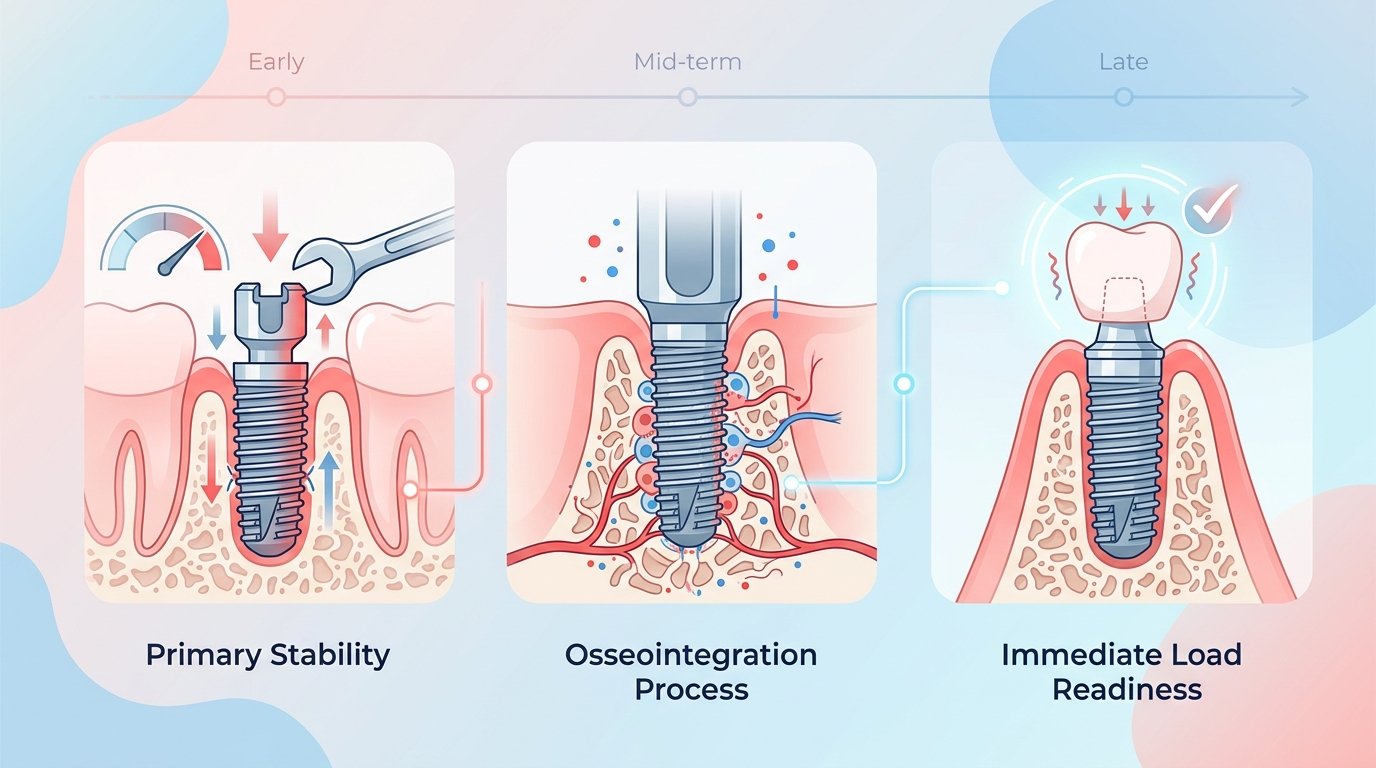
To understand why ISQ matters so much, it is worth distinguishing two key concepts:
- Primary stability: this is the immediate mechanical fixation of the implant in the bone at the time of placement. It depends on bone density, surgical technique and implant design.
- Secondary stability: this develops over time thanks to osseointegration, the biological process by which bone grows and adheres to the implant surface. It is the definitive and lasting stability.
High initial ISQ values (70 or more) tend not to increase over time, although the high mechanical stability will gradually be replaced by a developed biological stability. Lower initial values, on the other hand, usually increase over time thanks to the bone remodelling process.
This behaviour explains why monitoring with Osstell over time is so valuable: it allows detection of whether osseointegration is progressing correctly or whether there are early signs of peri-implantitis or other complications, before they become visible on a conventional X-ray.
When can immediate loading be performed? The ISQ > 70 threshold
Immediate loading consists of placing the crown or prosthesis on the same day as the implant surgery, without waiting for the traditional healing period of several months. For the patient, the advantage is clear: they leave the clinic with the tooth already in place.
But not all implants are candidates. The scientific evidence is clear: with more than 1,500 scientific references, we know that high stability means an ISQ > 70, between 60 and 69 is medium stability and below 60 is considered low stability. Only in the green zone is it safe to consider loading on the same day. The Osstell meter allows this threshold to be verified objectively and immediately before making the decision.
Studies such as those by Kokovic et al. (2013) and Bornstein et al. (2009) demonstrate that implants with ISQ > 70 can be loaded predictably and with excellent long-term survival rates. An increase of 10 points on the ISQ scale (from 60 to 70) corresponds to approximately 50% greater implant stability, a very significant biological difference.
If the ISQ value is below 70, there is no cause for concern: a delayed loading protocol is simply established, with periodic Osstell checks until it is confirmed that osseointegration has reached the necessary level. Studies in patients with simultaneous sinus lift show that 83% of implants reach the ISQ ≥ 70 threshold after 8 weeks of healing, with an early failure rate of 0.9%.
Osstell compared to other evaluation methods
Before resonance frequency analysis existed, clinicians relied on much less precise methods to evaluate implant stability:
- Percussion test: this involves lightly tapping or percussing the implant and listening to the resulting sound. It is subjective and depends on the professional’s experience.
- X-ray: useful for seeing the amount of bone, but it does not detect micro-movements or provide information about the quality of the bone-implant interface in real time.
- Insertion torque: measures the resistance of the implant during placement, but only provides a single data point at that moment, with no possibility of subsequent monitoring.
The Osstell system, on the other hand, uses resonance frequency analysis (RFA), which measures the frequency at which the device vibrates; by comparing resonance frequencies, implant stability can be determined, since the resonance frequency changes with different levels of stability. It is objective, reproducible and can be repeated at each follow-up visit.
Osstell at Platón Dental: a commitment to precision implantology
At Platón Dental we have the Osstell® ISQ system as part of our standard implantology protocol. This means that every patient who receives a dental implant in Palma or Manacor benefits from an objective Osstell measurement at the time of placement and at subsequent check-ups.
We do not make decisions about when to load your implant based solely on the time elapsed or on clinical feel. We measure it. And that data, backed by more than 1,500 scientific studies, is what guides every step of the treatment.
Because your smile deserves decisions based on evidence, not assumptions. That is what it means, for us, to offer the best technology for dental implants.